


Three Methods and Advantages of Laser Remanufacturing Technology
Contact Info
- Add:西安市国家民用航天产业基地航天基地299号西安建工科技创业基地十号楼4层, Zip:
- Contact: 段纯
- Tel:17392761868
- Email:gsjgkj@163.com
Other Products


In the early 1990s, laser remanufacturing technology emerged as a hot topic in scientific research, with most experts focusing on its study. As the concept of remanufacturing gradually gained social acceptance and technology continued to advance, China's remanufacturing industry has achieved significant accomplishments. The industrial scale has continuously expanded, covering a broader range of sectors with increasingly higher levels of intelligence, making it a new highlight in laser processing technology in recent years.
Currently, China has entered a peak period for the retirement and replacement of automobiles, engineering machinery, and machine tools, presenting a valuable opportunity for the development of the remanufacturing industry, which holds enormous potential. Laser remanufacturing technology has essentially matured, heralding the arrival of a high-end, intelligent market for laser remanufacturing.
Laser remanufacturing technology is a relatively new technological approach that has emerged in recent years. It primarily involves laser cladding, laser quenching, and laser surface alloying techniques to restore damaged components to their pre-damage functionality or even better performance.
Laser cladding is the preferred method in laser remanufacturing technology. It utilizes a high-energy laser beam as a heat source to rapidly melt, spread, and cool metal and welding materials, forming a surface layer with special functions. This layer typically offers wear resistance, corrosion resistance, heat resistance, oxidation resistance, and other properties. The advantage of laser cladding lies in the metallurgical bond between the cladding layer and the substrate, minimal heat-affected zones in the substrate, low processing and thermal deformation, and effective control over defects such as pores, inclusions, and cracks.
Laser quenching is the process of using a focused (or beam-shaped) laser beam to heat the metal surface, inducing a martensitic phase transformation to form a martensitic hardened layer. After laser quenching, the surface roughness of the workpiece remains largely unchanged, eliminating the need for subsequent mechanical machining to meet practical operational requirements.
Laser alloying, on the other hand, involves the interaction of alloy powder with the substrate material under laser irradiation to form a new phase as a surface treatment method.
The application of laser processing technology in the remanufacturing industry, much like in other manufacturing sectors, offers irreplaceable advantages over other processing technologies. The use of laser processing in remanufacturing has evolved from phase transformation hardening to laser surface alloying and laser cladding, and from laser alloy coatings to composite coatings and ceramic coatings, making laser surface modification technology a critical tool in remanufacturing.
The emergence of laser remanufacturing technology has broken the constraints of traditional remanufacturing techniques in terms of repairable materials and the shapes of repairable parts, overcoming the limitations of remanufacturing technology. The use of laser remanufacturing technology to repair high-temperature, high-pressure, and high-speed turbine power machinery components has been recognized and applied across more than a dozen industries, including petrochemicals, power generation, coal mining, metallurgy, and automotive.
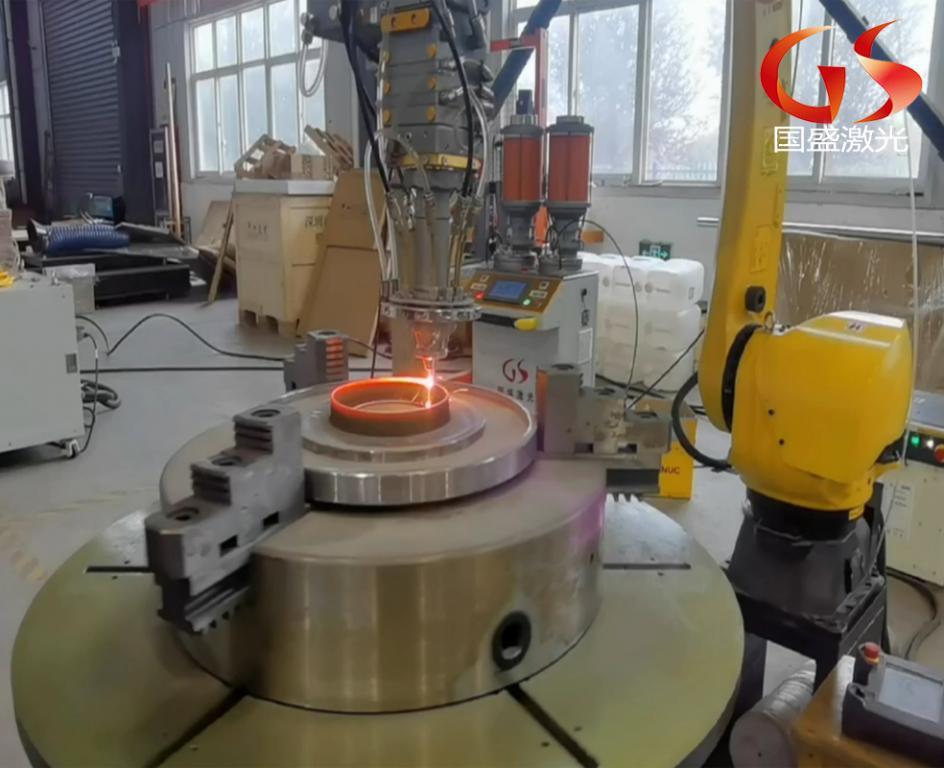
The eight-axis linkage laser cladding equipment, independently developed by Guosheng Laser, is a laser cladding processing system centered on robotic motion, capable of adapting to various complex structures and non-standard parts. The system offers flexible and diverse configurations, allowing for the selection of different specifications of robots based on customer application scenarios, along with optional positioners, rotary tables, and sliding tables to accommodate laser cladding processing and surface treatment for different types of workpieces. The equipment primarily consists of front-end execution mechanisms and back-end devices. The front-end execution mechanisms include robotic arms, positioners, electrical control systems, laser cladding heads, and cladding nozzles. The back-end devices include specialized cladding lasers, dedicated cladding water chillers, voltage-stabilized power supplies, and powder feeders.
| Industry Category | Others |
|---|---|
| Product Category | |
| Brand: | 国盛激光 |
| Spec: | |
| Manufacturer: | 西安国盛激光 |
| Origin: | 116101 |


