


Application of Laser Quenching Technology in the Automotive Parts Manufacturing Process
Contact Info
- Add:西安市国家民用航天产业基地航天基地299号西安建工科技创业基地十号楼4层, Zip:
- Contact: 段纯
- Tel:17392761868
- Email:gsjgkj@163.com
Other Products


Laser quenching, also known as laser transformation hardening technology, utilizes high-energy laser as a heat source to quench the metal surface through rapid heating and cooling, thereby completing the quenching process instantaneously and obtaining a high-hardness, ultra-fine martensitic structure. This method can enhance the hardness and wear resistance of the metal surface while forming compressive stress, thereby improving fatigue strength.
Characteristics of laser quenching and several different expressions:
1. High processing efficiency: Through rapid heating (105~106ºC/s) and rapid self-cooling (105 ºC/s), scanning speed and productivity can be improved, thereby replacing traditional quenching methods.
2. Uniform and controllable quenching quality: Laser transformation hardening has higher hardness compared to conventional transformation hardening and can achieve an extremely fine hardened layer structure. Using high-power lasers, a hardened layer depth of up to 2mm can be achieved. The quenching quality is controllable, and laser transformation hardening has advantages over conventional transformation hardening, allowing for a finer hardened layer while using high-power lasers to increase the depth of the hardened layer to 2mm.
3. Minimal processing deformation: Due to the fast laser heating speed, the heat-affected zone is relatively small. This results in relatively low transformation hardening stress and deformation.
4. Selectable quenching areas: There are multiple options for areas that can be quenched, enabling the hardening of parts with complex shapes and those that cannot be treated using other conventional methods, such as parts with grooves.
5. High degree of automation: The process can be automated through computer control, achieving a high level of automation. This high degree of automation allows the product production process to be integrated into automated production lines, thereby improving production efficiency.
6. Environmentally friendly: Laser transformation hardening uses self-cooling through heat conduction, eliminating the need for cooling media such as water or oil, and does not require the addition of functional alloy materials, achieving environmental protection and energy savings.
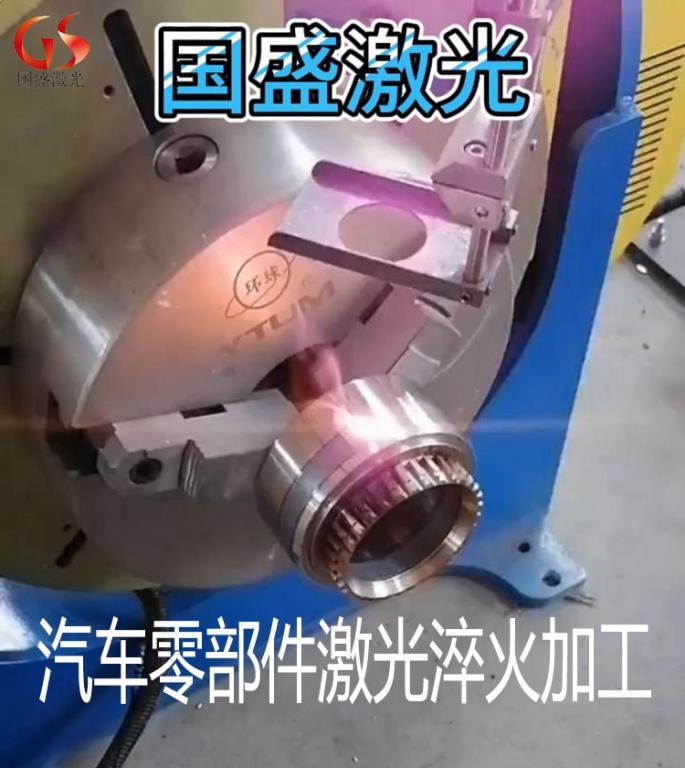
Application Background
In the automotive industry, the processing and manufacturing of most components rely on automotive molds. The quality and precision of automotive molds directly affect the processing quality, efficiency, and service life of automotive parts. Particularly during the manufacturing process, the surface processing quality, strength, and hardness of automotive molds are crucial. If the surface processing quality of automotive molds is substandard, it may cause damage to the mold surface during clamping and demolding processes, leading to a shortened service life. Traditional heat treatment processes require high control standards. Slight negligence can result in defects such as deformation, cracks, and dents in the workpiece, ultimately affecting its service life. Therefore, heat treatment technology has been widely applied in the treatment of automotive molds. With the rapid development of laser processing technology, laser quenching, as a new surface quenching process, has been further developed and applied. Laser quenching uses high-energy-density laser beams to irradiate the workpiece surface, making the quenching process more uniform and rapid, while significantly improving properties such as surface hardness, wear resistance, and corrosion resistance after quenching. Laser quenching offers the following advantages: First, the quenching process has a short temperature duration and high efficiency, greatly improving production efficiency; second, the surface hardness, wear resistance, and corrosion resistance of the workpiece are significantly enhanced after quenching, effectively extending the service life of the mold; additionally, laser quenching does not cause defects such as deformation, cracks, or dents in the workpiece, ensuring its precision and quality. Laser quenching has broad application prospects in the automotive industry, effectively improving the precision and quality of automotive molds, extending their service life, and enhancing production efficiency and workpiece quality.
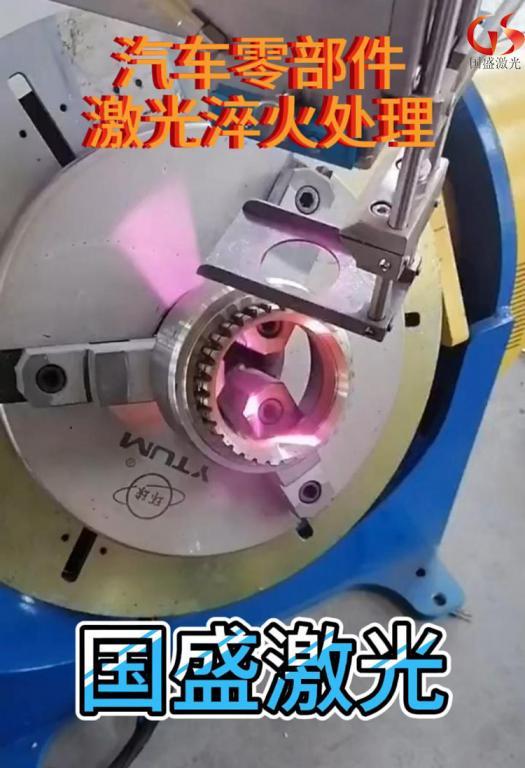
Application Examples
In recent years, with the rapid development of the automotive industry, laser surface quenching technology has been widely applied in the heat treatment of automotive molds. For example, quenching and strengthening of surfaces of automotive molds such as stamping molds, drawing molds, and injection molds have been widely used.
Thanks to its unique advantages in the field of heat treatment, the application scope of laser quenching in automotive manufacturing is becoming increasingly broad. For instance, laser quenching can be used to strengthen automotive components such as gears, shafts, and structural parts, thereby extending their service life. In fact, many foreign automotive manufacturers have explicitly stipulated that certain components must be strengthened using laser quenching.
Additionally, laser quenching can perform continuous constant-temperature heat treatment on cutting edges without causing edge collapse, thereby improving the hardness and lifespan of the edge area. Moreover, with the continuous popularization and development of laser technology, the application of laser quenching technology in the automotive industry will become increasingly widespread.
| Industry Category | Hardware & Tools/Cutting Power Tools/Drill Bits |
|---|---|
| Product Category | |
| Brand: | 国盛激光 |
| Spec: | |
| Manufacturer: | 西安国盛激光 |
| Origin: | 116101 |


