


Challenges Facing Laser Cladding Technology
Contact Info
- Add:西安市国家民用航天产业基地航天基地299号西安建工科技创业基地十号楼4层, Zip:
- Contact: 段纯
- Tel:17392761868
- Email:gsjgkj@163.com
Other Products


Currently, there is such a situation in the domestic laser cladding field. New processes are continuously being tested in university laboratories, but there is no platform to achieve real application verification. Factory enterprises are slow to update laser cladding processes and lack the support of cutting-edge scientific research capabilities. This disconnection between industry, academia, and research severely restricts the development of China's laser cladding industry.
The cost of laser cladding has always been a key factor limiting its development. Equipment investment, R&D investment, labor costs, powder costs, etc. The high price of laser cladding products is largely related to the large scale, high costs, and high processing costs per unit product of most laser processing enterprises. One or two pieces of equipment have low processing efficiency and cannot handle large-scale processing. Dozens of pieces of equipment have high processing efficiency, but the initial investment in equipment is too large, and a large number of equipment lie idle when there is no workload, which ordinary enterprises cannot afford.
The cost of laser cladding alloy powder is another major expense besides equipment costs. For small-scale production, powder manufacturing and procurement costs account for a large portion of the product cost. Only through bulk purchasing and usage can the overall product cost be reduced. At the same time, due to various mechanical processes after laser cladding, the actual cladding layer does not have the thickness of the initial cladding layer. Therefore, improving subsequent processing accuracy and reducing the initial cladding layer thickness have become inevitable for cost reduction.
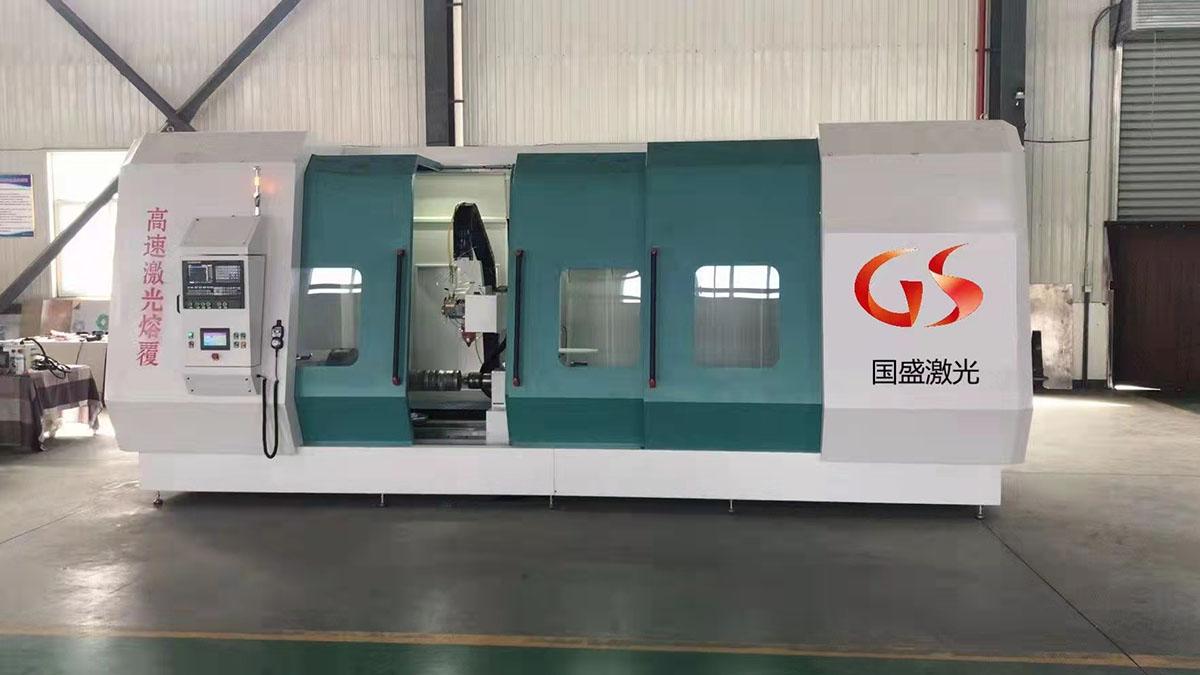
The machine tool-type high-speed laser cladding equipment developed by Xi'an Guosheng Laser effectively reduces cladding costs. This equipment is used to replace the chromium plating process for shaft mechanical parts, with a deposition efficiency 3-5 times that of traditional laser cladding. Specially designed and optimized high-speed laser cladding nozzles, large-capacity high-precision dual-barrel powder feeders, and high-precision CNC machine tools ensure extremely high powder utilization, long-term powder feeding stability, and uniform cladding layer properties. The equipment mainly consists of a high-power laser, high-precision CNC machine tool, high-speed laser processing head, high-precision powder feeder, cooling system, and control system.
Its advantages are as follows:
1. Precise laser energy control ensures the dilution rate of the cladding layer is controlled within 3%.
2. The use of specially designed and optimized high-speed laser cladding nozzles results in a powder utilization rate greater than 90%.
3. Large-capacity high-precision dual-barrel powder feeders ensure long-term powder feeding stability and uniform consistency of the cladding layer.
4. High-precision CNC machine tools enable cladding line speeds of 100-500 mm/s, with a cladding area of 0.5-1 m² per unit time.
5. High-precision powder feeding control allows for precise control of the melted coating thickness from 0.2 mm to 10 mm.
6. Suitable for laser cladding of shaft parts in various industries: coal mining industry—hydraulic supports, oil industry—oil rods, printing industry—cylinders, engineering machinery industry—hydraulic rods, power industry—boiler superheater tubes, etc.
Although laser cladding has many advantages and will eventually become a mainstream process, the price of laser cladding products on the market is not acceptable to most customers, and users have doubts about product performance. Therefore, replacing electroplated columns with laser cladding columns faces significant obstacles, and the laser cladding industry still has a long way to go.
| Industry Category | Others |
|---|---|
| Product Category | |
| Brand: | 国盛激光 |
| Spec: | |
| Manufacturer: | 西安国盛激光 |
| Origin: | 116101 |


