


Laser cladding technology for the repair and reinforcement of components.
Contact Info
- Add:西安市国家民用航天产业基地航天基地299号西安建工科技创业基地十号楼4层, Zip:
- Contact: 段纯
- Tel:17392761868
- Email:gsjgkj@163.com
Other Products


In the production processes such as steelmaking, various hot and cold rolling production lines, and galvanizing lines, a large number of high-load, high-speed, high-precision, and high-alloy load-bearing equipment are extensively used. Their components operate under production conditions, leading to corrosion, wear, fatigue damage, or failure. However, these numerous equipment components result in substantial production consumption in steel production, occupying a significant portion of production costs and causing considerable resource waste. According to preliminary estimates, the annual consumption of critical components in various rolling production lines in China's steel industry amounts to 10 billion yuan. Traditional methods primarily involve replacing these components, even if they are unusable and scrapped or the entire machine is replaced, necessitating a large inventory of spare parts, which occupies enormous capital and resources. Simultaneously, damaged, failed, or scrapped components or entire machines are mostly treated as waste, creating a chain of resource and capital waste that is astonishingly high.
The effective application of high-tech solutions such as laser cladding technology, laser rapid prototyping technology, laser nano-alloying, and surface strengthening technology has opened up a全新的 approach for the repair and transformation of such equipment and parts. It not only revives failed or scrapped equipment and components but also extends the service life of new products, even achieving multiple life cycles. For instance, numerous components prone to wear and fatigue, such as drive couplings, fork heads, intermediate shafts, transmission gears, universal joints, flat head sleeves, roller shafts, flying shears, roller end sleeves, coiler spring seat boxes, gear shafts, and reducer housings, used in various cold and hot rolling steel production lines, have been restored to the technical specifications of original new parts through laser cladding and rapid prototyping technologies. Moreover, most of them can achieve extended service life cycles, allowing for multiple repairs and achieving long-term usage effects.
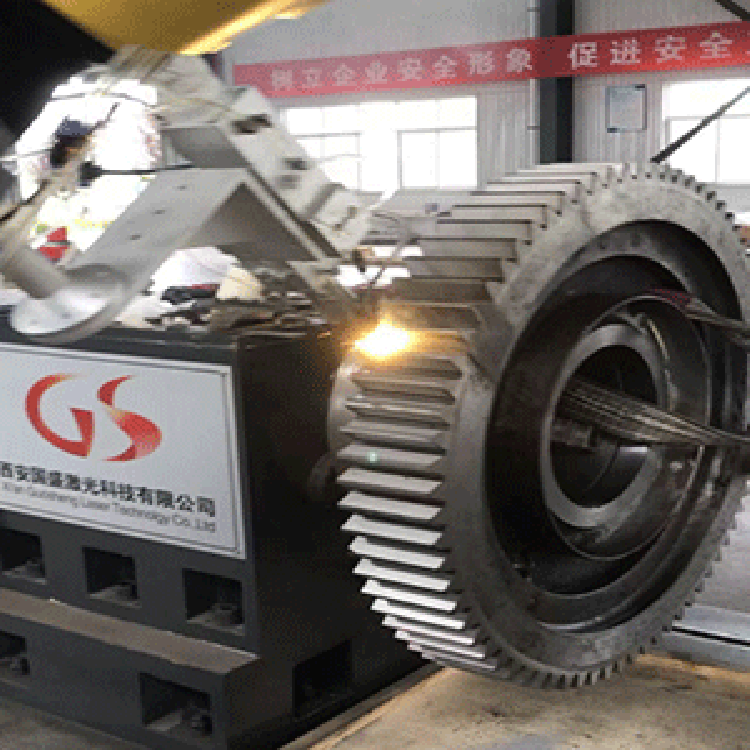
Various roller components on rolling production lines, such as work rolls, conveyor rolls, backup rolls, vertical rolls, guide rolls, and oscillating rolls, are made from different materials including forged alloy steel, cast alloy steel, alloy cast iron, and ductile iron. These roller parts operate under conditions of high temperature, high alternating loads, thermal cycling, corrosion, wear, and fatigue. Preliminary statistics indicate that the annual consumption of various rollers in China's steel enterprises amounts to approximately 8-10 billion yuan. Surface strengthening through laser nano-ceramic (raw material: non-metallic minerals) alloying and laser composite strengthening technology enhances surface strength, hardness, wear resistance, thermal stability, red hardness, corrosion resistance, fatigue resistance, and other performance indicators, effectively increasing the steel throughput of the rollers. This technology has been applied in several steel enterprises, with the service life of various rollers, including work rolls, generally increasing by 50% to several times.
For example, backup rolls are widely used in cold and hot production lines for rolling medium and thin steel plates, with weights ranging from over 30 tons to more than 120 tons. Backup rolls are made from cast steel and forged steel, respectively. Currently, many large backup rolls rely on imports. Backup rolls are passive rollers that experience complex forces during use. During operation, they are subjected to compression at the front, direct pressure below, tension at the rear, and shear stress in the deep layers. Consequently, backup rolls endure alternating loads of compression, pressure, tension, and shear while working. Near the contact points, the working sections of the roller body spall, with the spalled areas being the parts subjected to higher stress. The traditional maintenance method for failed small backup rolls is arc surfacing. However, the performance and lifespan of backup rolls repaired this way do not reach the level of new rollers. Currently, large backup rolls cannot be repaired using conventional arc surfacing methods and must be scrapped. Laser rapid prototyping technology can be used to repair backup rolls of various specifications and materials. Based on the material and performance requirements of different backup rolls, alloy materials superior to the original roller body material can be designed and used for laser rapid prototyping, resulting in repaired backup rolls with strength, wear resistance, corrosion resistance, fatigue resistance, and service life indicators that exceed those of new backup rolls. According to current calculations based on China's annual steel production of 470 million tons, the annual consumption of backup rolls is approximately 1 billion yuan. Laser rapid prototyping technology and remanufacturing engineering technology can generate considerable economic benefits and profound social benefits.
Practice has proven that if roller surfaces undergo laser quenching, their hardness can increase from the original 68 HSD to 78–82 HSD, and the service life of the rollers can be extended from the original 8-hour replacement cycle to 24 hours. This alone can reduce roller consumption costs in steel enterprises by about 50% and increase rolling production by 5%–10%. The benefits vary with the scale of rolling, ranging from 80 million to 300 million yuan. Laser cladding equipment refers to the process where selected coating materials are placed on the cladding substrate surface through different feeding methods, then melted with a thin layer of the substrate surface via laser irradiation, and rapidly solidified to form a surface coating with extremely low dilution and metallurgical bonding with the substrate. This significantly enhances the wear resistance, corrosion resistance, heat resistance, oxidation resistance, and electrical characteristics of the substrate surface, achieving the purpose of surface modification or repair. It not only meets the requirements for specific surface properties of materials but also saves a large amount of precious elements.
| Industry Category | Others |
|---|---|
| Product Category | |
| Brand: | 国盛激光 |
| Spec: | |
| Manufacturer: | 西安国盛激光 |
| Origin: | 116101 |


