


Automotive Engine Crankshaft Laser Quenching Repair Processing
Contact Info
- Add:西安市国家民用航天产业基地航天基地299号西安建工科技创业基地十号楼4层, Zip:
- Contact: 段纯
- Tel:17392761868
- Email:gsjgkj@163.com
Other Products


As a modern means of transportation, the performance and lifespan of an automobile engine are directly related to the overall performance of the vehicle. Among its components, the crankshaft, as the most critical rotating part of the engine, bears periodic alternating loads. Its surface hardness and wear resistance are crucial for the reliable operation of the engine. However, with prolonged use, wear and fatigue damage inevitably occur on the crankshaft surface, directly affecting the engine's efficiency and lifespan. To address this issue, laser quenching repair processing technology has emerged, providing an efficient, precise, and environmentally friendly solution for the surface hardening of crankshafts.
Laser quenching technology is an advanced surface treatment technique that uses a high-energy laser beam to irradiate the crankshaft surface, rapidly heating the material above the austenite phase transformation point in a short time. Subsequently, the material undergoes rapid self-cooling by the substrate, forming a hardened layer with high hardness and excellent wear resistance. This process eliminates the need for traditional quenching media, significantly reducing environmental pollution while enabling precise heating and cooling control of the crankshaft surface.
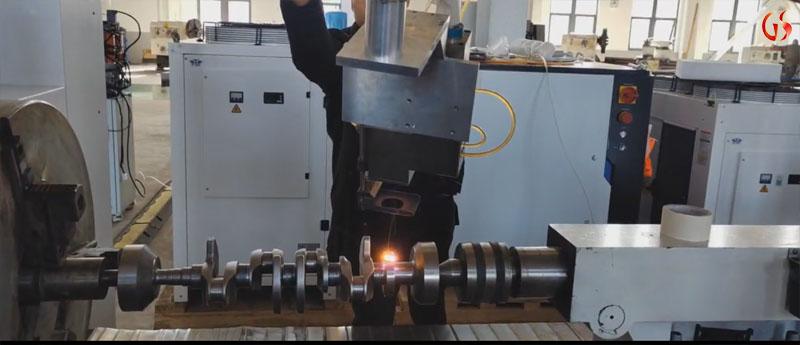
Before performing laser quenching repair processing on a crankshaft, a comprehensive inspection and preparation are necessary. First, the crankshaft surface must be cleaned to remove oil stains, rust, and other impurities, ensuring surface cleanliness, which is fundamental to guaranteeing the quality of laser quenching. Second, the surface flatness, roughness, and the presence of defects such as cracks must be checked to ensure they meet the requirements for laser quenching. For surfaces that do not meet the standards, necessary pre-treatments, such as grinding and polishing, are required to improve laser absorption efficiency and quenching effectiveness.
The selection and adjustment of the laser quenching machine are also critical steps. Based on the material and dimensions of the crankshaft, parameters of the laser quenching machine, such as laser power, scanning speed, and spot size, must be adjusted. Precise control of these parameters directly affects the hardness, depth, and uniformity of the quenched layer. Additionally, to ensure the laser beam scans the crankshaft surface along a predetermined trajectory, appropriate fixtures and positioning systems must be selected to ensure the perpendicularity and relative positional accuracy between the crankshaft and the laser beam.
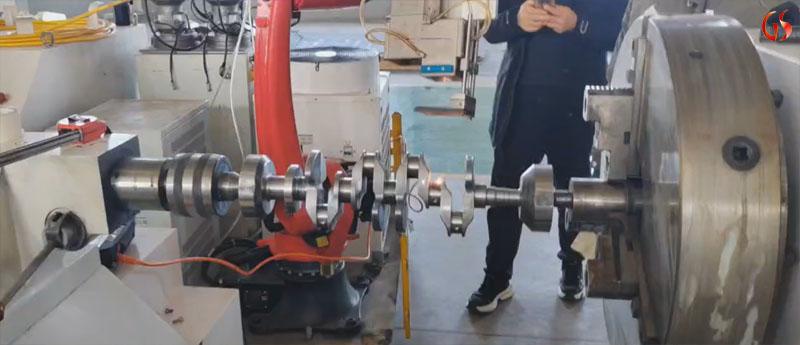
During the laser quenching process, the laser beam rapidly scans the crankshaft surface along a predetermined trajectory. As the laser moves, the crankshaft surface quickly heats above the austenite phase transformation point, forming a high-temperature gradient. Under high temperatures, atoms in the material migrate and rearrange, forming a new microstructure. When the laser beam moves away, the heated surface rapidly cools through self-cooling by the substrate, forming a hardened layer with high hardness. This process not only enhances the surface hardness and wear resistance of the crankshaft but also improves the material's fatigue resistance.
It is worth noting that the thermal and organizational stresses generated during the laser quenching process must be effectively controlled. To prevent crankshaft deformation or cracking due to excessive stress, preheating before quenching or tempering after quenching may be necessary. These measures help balance the internal stress state of the material, improving the overall performance of the crankshaft.
After the laser quenching repair processing is completed, necessary post-processing and quality inspection of the crankshaft are required. First, the quenched crankshaft undergoes treatments such as polishing and cleaning to remove surface scale and residues. Then, quality inspections of the hardened layer are conducted, including hardness testing, wear resistance testing, and metallographic structure observation. These tests help evaluate the effectiveness of the laser quenching and whether the performance of the hardened layer meets the expected requirements.
Compared to traditional induction quenching, laser quenching technology offers significant advantages in crankshaft repair processing. First, laser quenching enables localized precise heating and cooling control, avoiding deformation issues caused by uneven temperature distribution in traditional quenching processes. Second, the hardened layer after laser quenching exhibits excellent uniformity, high hardness, and strong wear resistance, significantly extending the crankshaft's service life and reliability. Additionally, laser quenching technology is environmentally friendly, efficient, and easily automated, aligning with the development trends of modern manufacturing.
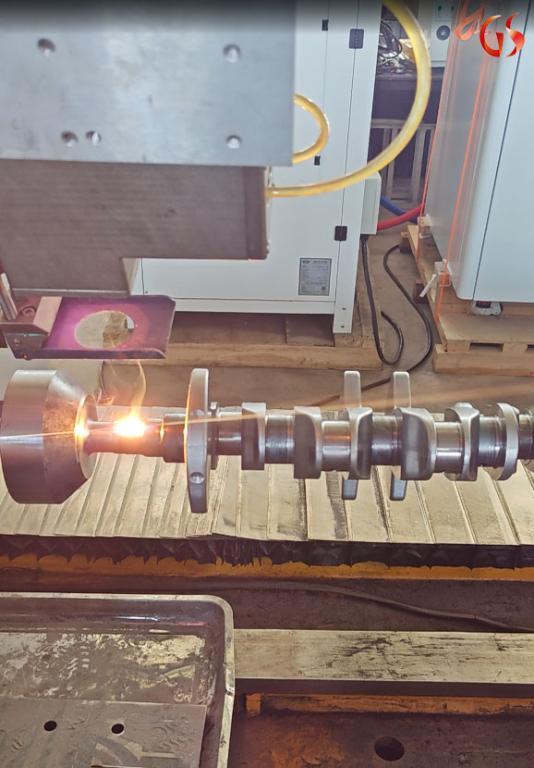
In practical applications, laser quenching technology has been successfully applied to the repair processing of crankshafts in various types of automobile engines. Whether for passenger cars, trucks, or engineering machinery engines, crankshafts can undergo surface hardening through laser quenching technology. Crankshafts treated with laser quenching not only exhibit improved surface hardness and wear resistance but also enhanced fatigue resistance, thereby extending the engine's service life and improving the overall vehicle's performance and reliability.
However, laser quenching technology also has certain limitations and challenges. For example, for large crankshafts or those with complex shapes, difficulties in focusing and scanning the laser beam may lead to uneven quenching effects or failure to meet expected requirements. Additionally, the high cost of laser quenching equipment and the need for specialized technical personnel for operation and maintenance limit its application in certain fields.
To overcome these limitations and challenges, researchers are continuously exploring and improving laser quenching technology. On one hand, optimizing laser beam parameters and scanning trajectories can enhance quenching effectiveness and uniformity. On the other hand, developing new laser quenching equipment and auxiliary systems can reduce costs and improve operational convenience. At the same time, combining laser quenching with other surface treatment technologies, such as spraying and carburizing, can further enhance the comprehensive performance of crankshafts.
In summary, laser quenching repair processing technology for automobile engine crankshafts, as an advanced surface treatment technique, provides an efficient, precise, and environmentally friendly solution for surface hardening. By optimizing laser quenching parameters and strengthening post-processing quality control, the service life and reliability of crankshafts can be significantly improved. With continuous technological advancements and expanding application areas, laser quenching technology will play an increasingly important role in the automotive manufacturing industry.
| Industry Category | Others |
|---|---|
| Product Category | |
| Brand: | 国盛激光 |
| Spec: | |
| Manufacturer: | 国盛激光 |
| Origin: | 116101 |


