


Laser Quenching Characteristics and Application Scope
Contact Info
- Add:西安市国家民用航天产业基地航天基地299号西安建工科技创业基地十号楼4层, Zip:
- Contact: 段纯
- Tel:17392761868
- Email:gsjgkj@163.com
Other Products


1. Laser Quenching and Its Characteristics
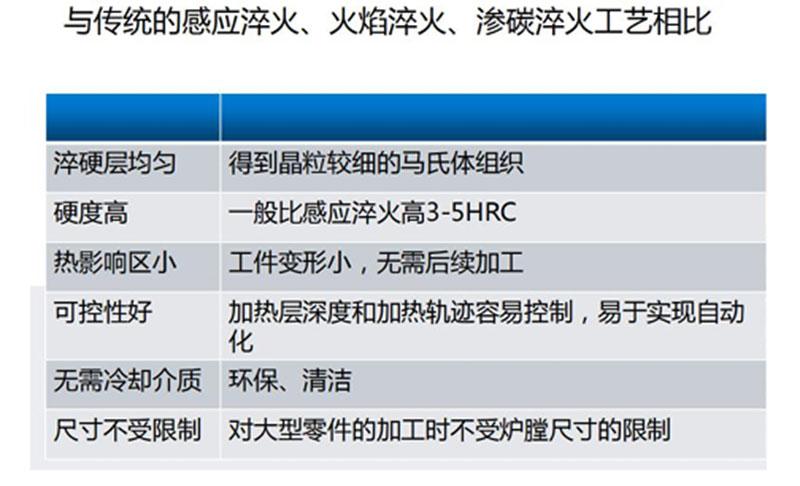
Laser quenching, also known as laser transformation hardening, involves irradiating a pre-treated workpiece with a laser beam of power density <104W/cm². This rapidly heats the workpiece surface to a temperature above the phase transformation point at a rate of 105~106°C/s. Under conditions where the austenite structure forms and the austenite grains have no time to grow, once the laser irradiation stops, the surface rapidly cools through the base material's own heat conduction (cooling rate can reach 104~106°C/s), achieving self-quenching and forming a surface transformation hardening layer.
2. Applicable Scope of Laser Quenching
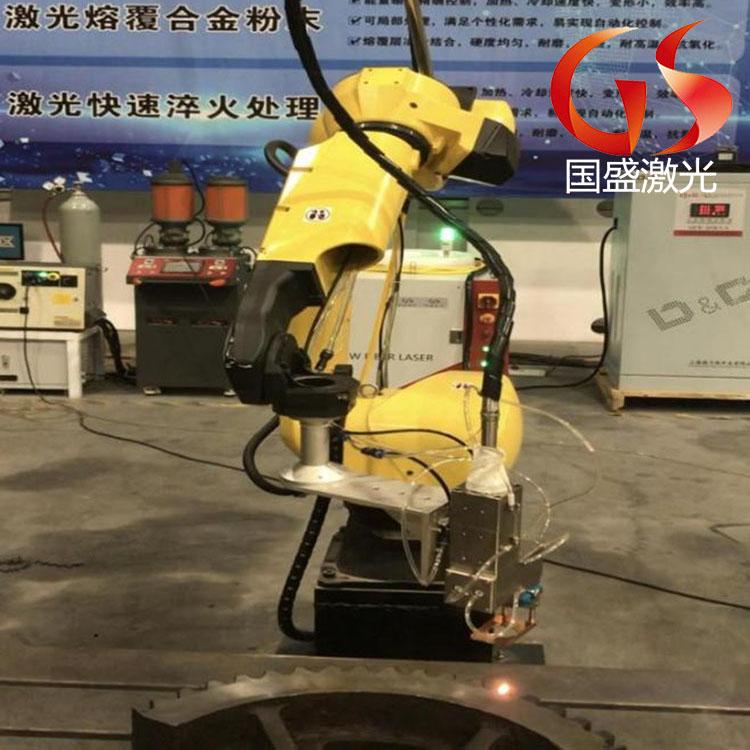
Laser quenching is typically used for surface hardening of workpieces that do not require overall quenching, have high dimensional accuracy requirements, are difficult to treat by other methods, or have complex shapes or require further improvement in properties such as hardness and wear resistance.
3. Common Materials for Laser Quenching
4. Surface Pretreatment
To enhance the absorption of laser radiation energy by the workpiece, a coating with high laser absorption capacity must be formed on its surface before laser quenching. This is generally achieved through phosphating or by applying coatings containing various light-absorbing substances (such as fine graphite powder with particle size <1μm + acrylic resin + mica powder + ketone; manganese phosphate or zinc phosphate + phosphoric acid; carbon ink + manganese phosphate).
| Industry Category | Machinery & Equipment/Electric Heating Equipment/Medium Frequency Power Supplies |
|---|---|
| Product Category | |
| Brand: | 国盛激光 |
| Spec: | |
| Manufacturer: | 国盛激光 |
| Origin: | 116101 |


