


Front-end high-speed laser cladding repair processing
Contact Info
- Add:西安市国家民用航天产业基地航天基地299号西安建工科技创业基地十号楼4层, Zip:
- Contact: 段纯
- Tel:17392761868
- Email:gsjgkj@163.com
Other Products


In today's industrial manufacturing sector, with the continuous advancement of technology, high-speed laser cladding repair processing technology has gradually become an important method for metal surface repair and strengthening due to its unique advantages. This technology not only effectively addresses issues such as low efficiency, high cost, and unstable quality found in traditional repair methods but also demonstrates its strong potential in a wider range of industrial applications.
I. Technical Principle
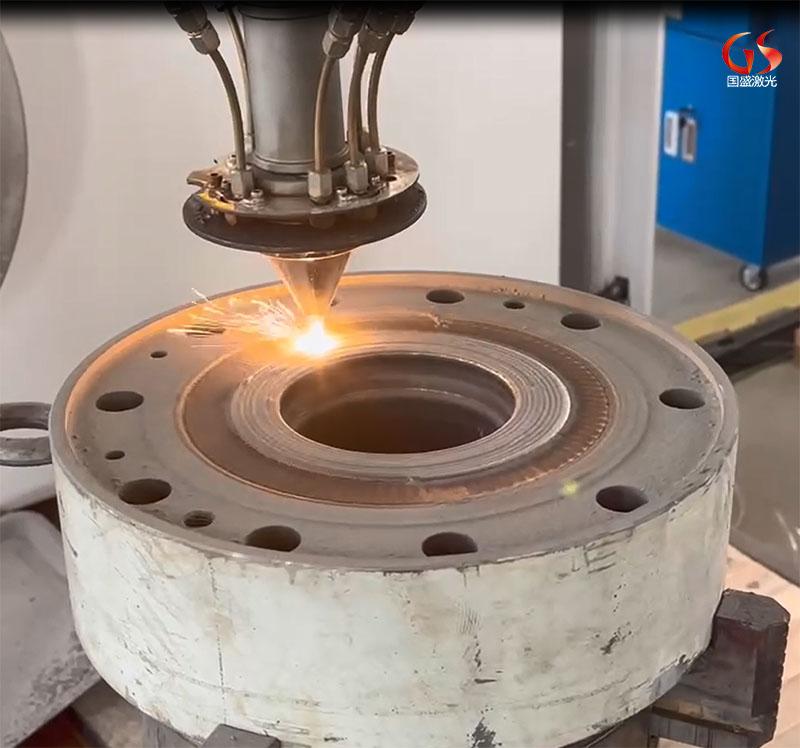
High-speed laser cladding repair processing technology is an advanced surface engineering technique that utilizes a high-power-density laser beam as a heat source to rapidly melt and deposit selected coating materials (such as metal powder or wire) onto the substrate surface of the workpiece to be repaired, forming a coating with excellent performance. During this process, a metallurgical bond occurs between the coating material and the substrate material, resulting in a cladding layer with extremely low dilution, significantly improving the substrate surface's wear resistance, corrosion resistance, heat resistance, oxidation resistance, and other properties.
The core of high-speed laser cladding repair processing lies in its high speed, high precision, and high efficiency. By optimizing the coupling method between the laser beam and the powder or wire, as well as employing advanced motion control systems and powder feeding systems, this technology achieves extremely high cladding line speeds and uniform cladding layer quality. Additionally, high-speed laser cladding offers significant advantages such as a small heat-affected zone, minimal workpiece deformation, and low coating dilution rate.

II. Process Flow
The process flow of high-speed laser cladding repair processing typically includes the following steps:
1. Workpiece Inspection and Pre-processing: First, conduct a comprehensive inspection of the workpiece to be repaired to determine the cladding area and the required thickness of the cladding layer. Subsequently, perform necessary pre-processing treatments on the workpiece, such as removing surface oxide layers, oil stains, and impurities, to ensure a strong bond between the cladding layer and the substrate.
2. Pre-cladding Preparation: Secure the workpiece onto specialized cladding equipment and perform precise positioning and alignment. Simultaneously, prepare the required coating materials (metal powder or wire) and auxiliary equipment (such as powder feeders and protective gas devices).
3. Laser Cladding Process: Start the laser cladding equipment and set appropriate process parameters such as laser power, cladding speed, and powder feeding speed. Control the motion trajectory of the laser beam and coating materials through a three-axis motion control system and rotating equipment to ensure the uniformity and consistency of the cladding layer. During the cladding process, closely monitor the quality of the cladding layer and changes in cladding temperature, adjusting process parameters in real-time to ensure optimal cladding results.
4. Post-processing and Inspection: After cladding is completed, perform necessary post-processing on the workpiece, such as removing excess coating material and conducting grinding and polishing. Subsequently, conduct quality inspections of the cladding layer, including tests for coating thickness, hardness, wear resistance, corrosion resistance, and other indicators. Ensure the cladding layer meets design requirements before delivery for use.
III. Technical Advantages
1. High Efficiency: High-speed laser cladding technology offers extremely high cladding line speeds and efficiency, enabling large-area surface repair and strengthening to be completed in a short time. This significantly improves production efficiency and reduces production costs.
2. High Quality: By precisely controlling the motion trajectory of the laser beam and coating materials and optimizing process parameters, high-speed laser cladding technology ensures the uniformity and consistency of the cladding layer. Additionally, a strong metallurgical bond forms between the cladding layer and the substrate, enhancing the coating's adhesion and service life.
3. Low Dilution Rate: Due to its high cladding line speed and short molten pool duration, high-speed laser cladding technology results in a very low dilution rate. This helps preserve the original properties of the substrate material and reduces the extent of the heat-affected zone.
4. Low Deformation: Because the laser beam energy is concentrated and the heat-affected zone is small, high-speed laser cladding technology causes minimal workpiece deformation during the repair process. This helps maintain the dimensional and shape accuracy of the workpiece.
5. Wide Applicability: High-speed laser cladding technology is suitable for surface repair and strengthening of various metal materials, such as iron-based, nickel-based, and cobalt-based alloys. Additionally, this technology can be applied to workpieces with complex shapes and structures, offering broad applicability.
IV. Application Prospects
With the transformation and upgrading of the manufacturing industry and the increasing demand for high-quality development, the application prospects of high-speed laser cladding repair processing will become even broader. In industries such as coal, metallurgy, and power, laser cladding technology can be used to repair and strengthen key components like various shaft parts, hydraulic supports, and boiler superheater tubes. In the aerospace sector, laser cladding technology can be applied to manufacture high-performance engine blades and turbine disks. In the automotive manufacturing industry, laser cladding technology can repair wear and damage to key components such as engine blocks and crankshafts. Furthermore, with the continuous development of 3D printing technology, laser cladding can be integrated with 3D printing to meet more complex and personalized repair and manufacturing needs.
In summary, as an advanced surface treatment technology, high-speed laser cladding repair processing offers significant advantages in enhancing workpiece performance, extending service life, and reducing production costs. With continuous technological advancements and expanding application fields, it is poised to play an increasingly important role in the future of manufacturing.
In modern manufacturing, high-speed laser cladding repair processing technology has become a shining star in the field of metal surface treatment and repair due to its efficiency, precision, and broad application prospects. This technology not only greatly improves production efficiency but also significantly enhances the performance of processed parts, bringing revolutionary changes to numerous industries. This article will provide an in-depth analysis of high-speed laser cladding repair processing technology, covering its technical principles, equipment composition, application examples, and future outlook.
| Industry Category | Others |
|---|---|
| Product Category | |
| Brand: | 国盛激光 |
| Spec: | |
| Manufacturer: | 西安国盛激光 |
| Origin: | 116101 |


