


Classification and Characteristics of Laser Cladding
Contact Info
- Add:西安市国家民用航天产业基地航天基地299号西安建工科技创业基地十号楼4层, Zip:
- Contact: 段纯
- Tel:17392761868
- Email:gsjgkj@163.com
Other Products


Laser cladding technology refers to the use of high-energy-density laser beams to irradiate the molten pool, raising its temperature to a supersaturated state. This causes elements in the molten pool to form dendrites or other amorphous substances, which flow at extremely high speeds to the surface of the molten pool and clad onto the workpiece surface, forming a new metallic layer with a certain thickness and performance. Compared to traditional overlay welding and electroplating, laser cladding technology offers many unique advantages.
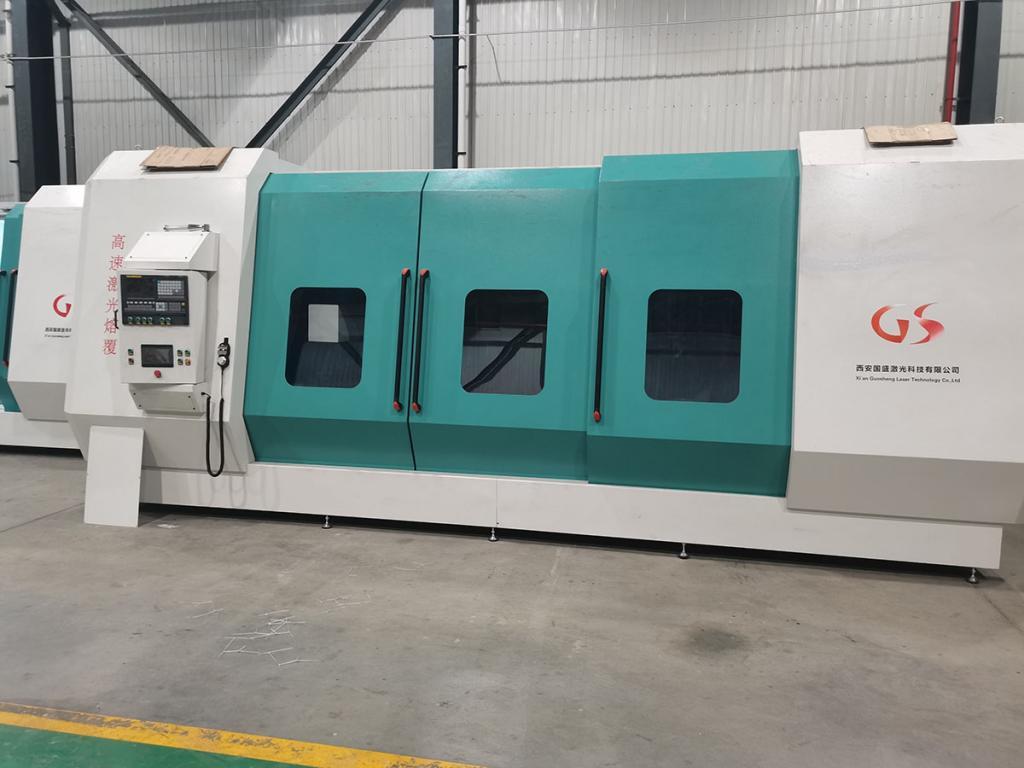
High-power laser cladding (HWS-WFJ) is a novel process that utilizes high-power fiber lasers to prepare cladding layers on metal substrates. Its characteristic is that it is not limited by the geometric shape of the part, enabling the fabrication of surfaces for workpieces with complex shapes, large sizes, and irregular forms. It is suitable for preparing parts with large dimensions, complex shapes, and special performance requirements.
Based on the heat source, laser cladding can be divided into the following two types:
One is laser cladding technology using fiber lasers as the heat source, also known as "laser beam additive manufacturing." This method is primarily used for surface strengthening to meet performance requirements in practical applications such as repair and remanufacturing. It enables surface modification and remanufacturing on various metal materials, including stainless steel, copper and copper alloys, aluminum and aluminum alloys.
The other is laser cladding technology using high-power semiconductor lasers as the heat source. This method is mainly used to improve the surface properties of special materials (such as ceramics and nanomaterials), such as high-temperature alloys and ceramic matrix composites.
Laser cladding technology involves irradiating the workpiece surface with high-energy-density laser beams, bringing the surface to a supersaturated state. Through rapid melting, expansion, solidification, and cooling, it achieves the process of repair and remanufacturing.
Based on the materials used, laser cladding is mainly divided into: metal laser cladding and composite material laser cladding.
Metal Laser Cladding
Laser cladding involves uniformly covering the material surface on the workpiece through laser cladding materials, heat sources, and cooling methods, achieving a functional remanufacturing process. Its essence lies in using high-power-density laser beams to clad metal onto the workpiece surface, forming a new metallic layer with a certain thickness and performance.
In terms of metallurgical principles, laser cladding involves laser-induced recrystallization of elements in the molten pool, causing the molten pool to solidify with unchanged volume while undergoing internal solidification, achieving metallurgical bonding. At the same time, laser cladding largely retains the properties of the base material, ensuring the workpiece remains fundamentally unchanged. It allows the use of one material to obtain workpieces with multiple different properties. In contrast, traditional processes use different base materials or parts as raw materials, selecting appropriate materials based on workpiece requirements and achieving metallurgical bonding for surface strengthening.
Composite material laser cladding refers to the use of functional materials (such as ceramics, nanomaterials, etc.) that have the same or similar properties as the workpiece material, cladding a layer of material with the same properties as the protected surface onto the workpiece surface.
Based on the cladding composition, composite material laser cladding can be divided into: ceramic laser cladding and metal laser cladding.
Currently, due to the differences in properties between ceramics and metal materials, metal laser cladding is generally predominant.
When using semiconductor lasers for laser cladding on ceramic matrix composites, if the laser power density is too high (generally exceeding 200 kW/cm²), the thermal stress between the metal substrate and the functional layer can cause uneven melting and solidification, leading to cracks in the cladding layer. When the power density is lower (generally not exceeding 30 kW/cm²), precise cladding can be achieved.
| Industry Category | Others |
|---|---|
| Product Category | |
| Brand: | 国盛激光 |
| Spec: | |
| Manufacturer: | 西安国盛激光 |
| Origin: | 116101 |


