


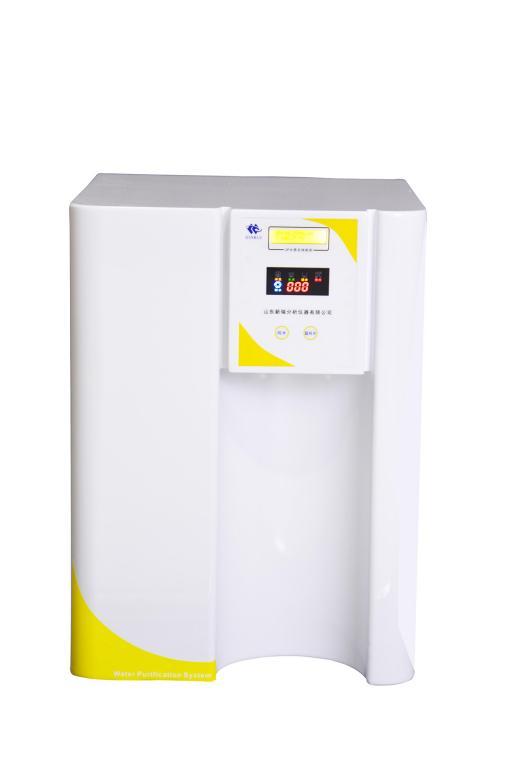


Ultrapure Water Treatment Equipment RUPF
Contact Info
- Add:山东省枣庄市滕州市东沙河街道东沙河村首康康路10号, Zip: 277500
- Contact: 李书典
- Tel:0632-5251855
- Email:sdxinruiq@163.com
Other Products


The demand for ultrapure water initially came from industries such as power generation, pharmaceuticals, chemicals, and papermaking, where water quality requirements were relatively low. Preparation primarily involved ion exchange, a method whose main drawbacks were chemical regeneration—both cumbersome and uneconomical—and the poor removal efficiency of general organic molecules by strong resins, resulting in high TOC levels in the effluent. With the development of the semiconductor industry, the quality requirements for ultrapure water increased, significantly advancing pure water technology. By the end of the last century, membrane technology saw widespread application, with microfiltration, ultrafiltration, electrodialysis, and reverse osmosis technologies advancing rapidly. Membrane-based pure water preparation replaced traditional ion exchange equipment systems, addressing TOC issues and meeting the water quality demands of the electronics industry. In membrane processes, ultrafiltration and microfiltration replaced clarification, quartz sand filters, and activated carbon filters to remove suspended solids, colloids, and organic matter from water, reducing turbidity, SDI, and COD. This ensured the safe and efficient operation of reverse osmosis systems for wastewater reuse. Reverse osmosis replaced ion exchangers for desalination, further removing organic matter, colloids, bacteria, and other impurities, ensuring that reverse osmosis effluent met the requirements for EDI feedwater. EDI replaced mixed beds for deep desalination, using electricity instead of acids and alkalis for resin regeneration, thereby avoiding secondary pollution.
Xinrui Laboratory Ultrapure Water Analysis Instrument Raw Water Pretreatment
Due to the nature of membrane materials and elements, reverse osmosis has certain requirements for feedwater quality. Pretreatment addresses issues such as clogging, scaling, fouling, and degradation. Clogging refers to the blockage of membrane element flow channels by particles, suspended solids, colloids, and iron oxide precipitates in the water. Scaling occurs when sparingly soluble salts crystallize and precipitate on the concentrated side, which can be prevented by pre-removal or the addition of scale inhibitors. Fouling involves the adsorption of oils, organic matter, microbial growth, and colloids on the membrane surface, addressed through disinfection, oxidative breakdown, flocculation filtration, and activated carbon adsorption. Degradation refers to oxidative damage to membrane materials by free chlorine, ozone, and other oxidants, mitigated by activated carbon adsorption or the addition of reducing agents.
Traditional Pretreatment Methods
Multimedia filters primarily remove organic matter through flocculation and capture, effective only for particulate or colloidal macromolecules but ineffective for dissolved natural organic matter and many industrial organic pollutants.
Activated carbon adsorption partially removes small-molecule organic matter through adsorption, with COD removal rates ranging from 40% to 90%. Activated carbon is not used for filtration and retention.
Membrane-Based Pretreatment
Membrane-based pretreatment provides reliable feedwater quality assurance for downstream desalination systems.
Filtration is a membrane separation process based on sieving principles, driven by pressure, with a filtration precision ranging from 0.005 μm to 0.01 μm. It effectively removes particles, colloids, bacteria, and high-molecular-weight organic matter from water. Ultrafiltration involves no phase change and exhibits good temperature resistance, acid and alkali resistance, and oxidative resistance. By using membrane materials with different molecular weight cut-offs and process designs, ultrafiltration can adapt to various water quality conditions and separation requirements.
Xinrui Laboratory Ultrapure Water Analysis Instrument Water Purification Equipment
Reverse osmosis, abbreviated as RO, primarily consists of high-pressure pumps and reverse osmosis membranes. Under high pressure, water molecules are separated from other substances in the water, such as minerals, organic matter, and microorganisms, which are flushed away by the high-pressure water flow. The permeate is safe, sanitary, and pure water. Leveraging the separation characteristics of reverse osmosis, it effectively removes dissolved salts, colloids, organic matter, bacteria, and other impurities. Reverse osmosis offers advantages such as low energy consumption, no pollution, advanced technology, and simple operation. It is widely applied in softening and desalination of makeup water, desalination of seawater and brackish water, production of drinking pure water, preparation of ultrapure water for the electronics industry, separation, concentration, and recovery in chemical and food industries, and other process water applications. Factors Affecting Reverse Osmosis Membranes
Recovery Rate: Excessively high recovery rates can cause membrane fouling or precipitation of dissolved salts in the concentrate, leading to scaling.
Temperature: Temperature affects both osmotic pressure and water flux. Water flux is proportional to temperature, typically correlating with the viscosity changes due to temperature. Generally, a 1°C increase in water temperature increases membrane output by 3%.
Pressure: For a given set of feedwater conditions, increasing pressure raises the water flow per unit membrane area. Although salt flux is unaffected by pressure, the increased water flow dilutes the salt passage through the membrane, resulting in lower salt concentration in the permeate.
RUPF Series Ultrapure Water System Performance Features
Automatic backwash upon startup
Low-pressure alarm shutdown protection; automatic cessation of water production when the tank is full
Simultaneous online monitoring of two water quality parameters, real-time monitoring of pure and ultrapure water quality
No-water alarm, full-water alarm, ensuring safety
Fully automatic RO membrane anti-scaling rinse program, extending RO membrane lifespan; automatic backwash at startup and automatic rinsing during standby when the tank is full
Dual-output water quality, one system for two uses (capable of simultaneously producing two streams of pure water)
Multiple storage tank specifications available to meet different needs
Ergonomically designed chassis, compliant with GLP standards
All pipelines NSF-certified; new quick-connect fittings for easier filter column replacement and maintenance
Imported nuclear-grade resin; fully descending flow ultrapurification column design, ensuring consistent water quality
Online monitoring of water temperature in the flow path
Dual-wavelength (185nm & 254nm) imported UV lamp, effectively sterilizing, reducing TOC, and enhancing system applicability
Imported 0.45μm PES polyethersulfone composite membrane terminal sterilizing filter, ensuring sterile water quality
Ultrapure water constant pressure system
Enhanced pretreatment with automatic startup after water use
RUPF Series Ultrapure Water System (Tap Water as Source)
Name Basic Type Pyrogen-Free Type Low Organic Matter Type Comprehensive Type
Product Model Standard Type RUPF RUPF-1 RUPF-II RUPF-III
Feedwater Requirements Municipal tap water: TDS <200 ppm, 5-45°C, 1.0-4.0 Kgf/cm² (If feedwater TDS >200 ppm, an external softener is recommended)
System Process PF+RO+AC+PF+
AC+DI+TF PF+AC+PF+RO+
AC+DI+UF+TF PF+AC+PF+RO+
UV+DI+TF PF+AC+PF+RO+
UV+DI+UF+TF
UP Ultrapure Water Indicators Resistivity 18.25 MΩ.cm@25°C
Heavy Metal Ions < 0.1 ppb
Total Organic Carbon (TOC) <10
| Industry Category | Environment/Raw Water Treatment Equipment/Other Raw Water Treatment Equipment |
|---|---|
| Product Category | |
| Brand: | 山东新瑞 |
| Spec: | RUPF |
| Stock: | 1000 |
| Manufacturer: | |
| Origin: | China / Shandong / Zaozhuangshi |


