


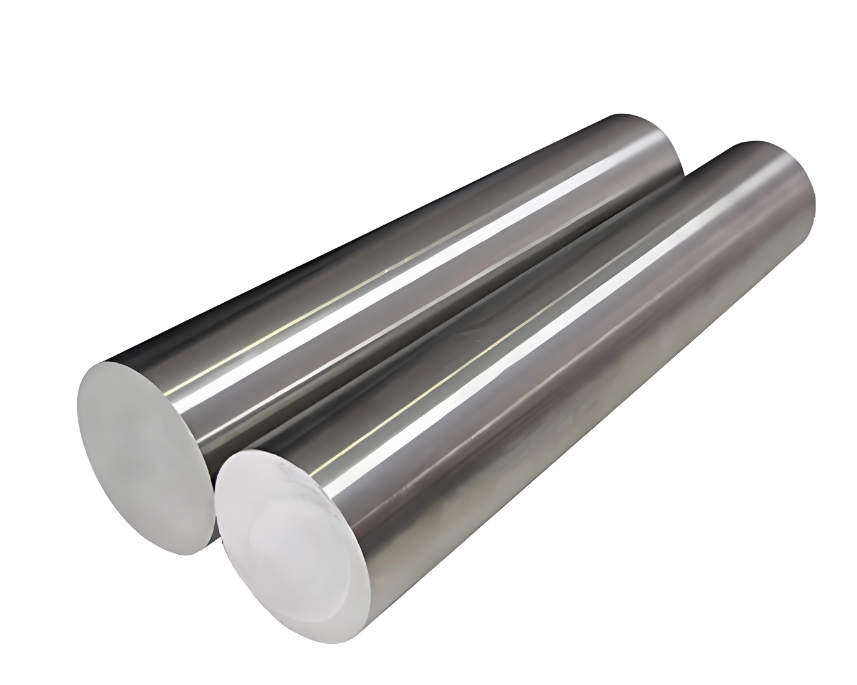
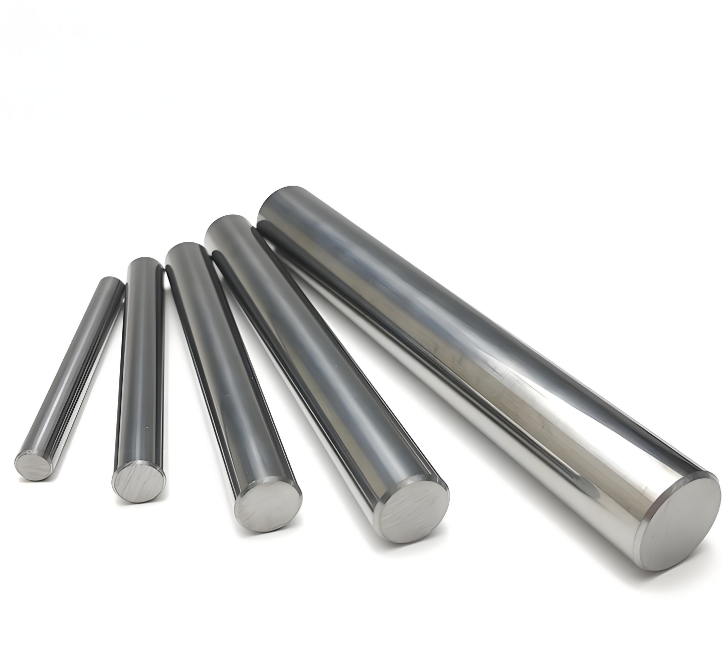
TC4 chamfered pure titanium rod, titanium alloy rod GR5, wear-resistant high-strength round bar.
Contact Info
- Add:261 Xinxing East Street, Juye Building, Zip:
- Contact: 董经理
- Tel:15832920400
- Email:1037882998@qq.com
Other Products


Execution Standard: ASTM B348-2010
TC4, also known as GR5, is often referred to as 6Al4V. It is the most widely used titanium alloy, and typically when we refer to titanium alloy, this is the one. It offers excellent strength and elongation.
Chemical Composition %
Ti: Balance Al: 5.5~6.75 V: 3.5~4.5 Fe: ≤0.4 C: ≤0.08 N: ≤0.05 H: ≤0.015 O: ≤0.20 Other Elements Single: ≤0.10 Total: ≤0.40
Mechanical Properties
Grade: GR5/Ti-6Al-4V
Room Temperature Mechanical Properties
Tensile Strength Rm/MPa: ≥895 (130)
Proof Strength Rp0.2/MPa: ≥828 (120)
Elongation After Fracture A/%: ≥10
Reduction of Area Z/%: ≥25
Applications
Titanium and its alloys are known for their light weight, high strength, heat resistance, and corrosion resistance, earning them the title "metal of the future." They are promising new structural materials. Titanium and its alloys are not only crucial in the aerospace industry but are also widely used in chemical, petroleum, light industry, metallurgy, power generation, and other industrial sectors. Titanium is resistant to corrosion by the human body and is non-toxic, making it suitable for medical and pharmaceutical industries. Titanium also has excellent gas absorption properties and is widely used in high-vacuum technology within electronic vacuum applications.
Our company specializes in the production and manufacturing of titanium and titanium alloys, compliant with both GB and ASTM standards. We offer a range of titanium materials, including medical-grade titanium, titanium tubes, titanium rods, titanium wires, titanium plates, titanium strips for heat exchangers, titanium foil, titanium welding wires, precision titanium machined parts, standard parts, and titanium forgings.
Titanium Alloy Classification
Titanium is an allotropic element with a melting point of 1668°C. Below 882°C, it has a close-packed hexagonal crystal structure, known as α-titanium; above 882°C, it transforms into a body-centered cubic crystal structure, known as β-titanium. By leveraging these two structures and adding appropriate alloying elements, the phase transformation temperature and phase composition can be adjusted to produce titanium alloys with different microstructures. At room temperature, titanium alloys are categorized into three types based on their matrix structure: α-alloys, (α+β)-alloys, and β-alloys. In China, these are designated as TA, TC, and TB, respectively.
α-Titanium Alloy
This is a single-phase alloy composed of α-phase solid solution. It remains stable as α-phase at both room temperature and higher practical application temperatures. It offers better wear resistance than pure titanium and strong oxidation resistance. It maintains strength and creep resistance at 500°C to 600°C but cannot be strengthened by heat treatment, resulting in relatively low room temperature strength.
β-Titanium Alloy
This is a single-phase alloy composed of β-phase solid solution. It has high strength in the as-cast condition and can be further strengthened by quenching and aging. Room temperature strength can reach 1372–1666 MPa. However, it has poor thermal stability and is not suitable for high-temperature applications.
α+β-Titanium Alloy
This is a dual-phase alloy with excellent comprehensive properties, good structural stability, toughness, plasticity, and high-temperature deformation performance. It can be effectively hot-worked and strengthened through quenching and aging. After heat treatment, its strength increases by about 50% to 100% compared to the annealed state. It offers high high-temperature strength and can operate long-term at 400°C to 500°C, though its thermal stability is inferior to that of α-titanium alloys.
Among the three types, α-titanium and α+β-titanium alloys are the most commonly used. α-titanium alloys have the best machinability, followed by α+β-titanium alloys, while β-titanium alloys have the poorest machinability. α-titanium alloys are designated as TA, β-titanium alloys as TB, and α+β-titanium alloys as TC.
| Industry Category | Metallurgy & Minerals/Non-Ferrous Alloys/Other Non-Ferrous Alloys |
|---|---|
| Product Category | |
| Brand: | 源铸 |
| Spec: | 0.8-500mm |
| Stock: | 2000 |
| Manufacturer: | 源铸商贸有限公司 |
| Origin: | 111305 |


