


Seismic Precision Pressure Gauge
Contact Info
- Add:陕西省西安市高新区锦业一路72号雄华科技园A座306室, Zip:
- Contact: 李女士
- Tel:02981028005
- Email:xygk029@163.com
Other Products


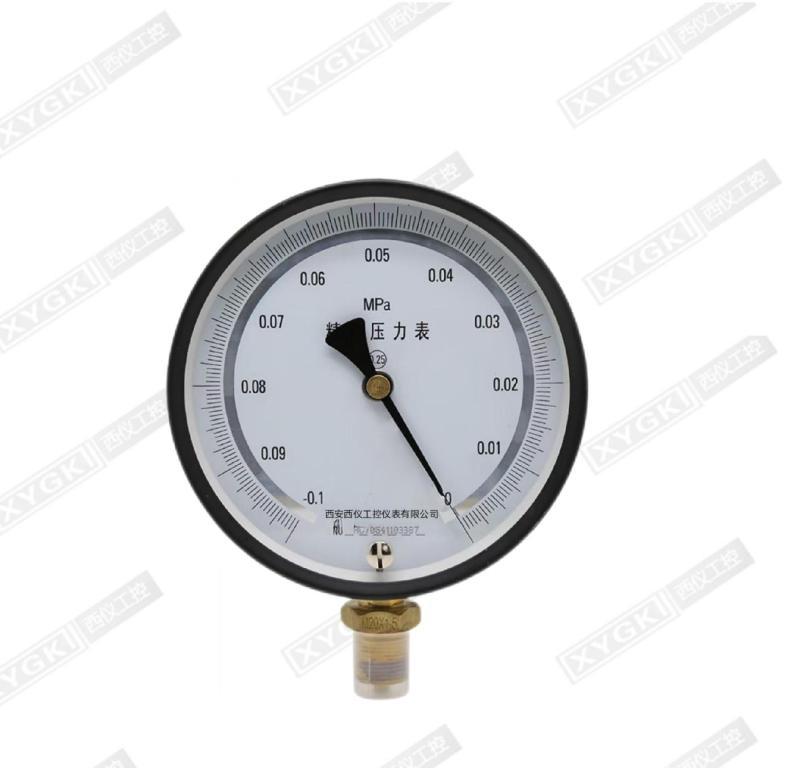
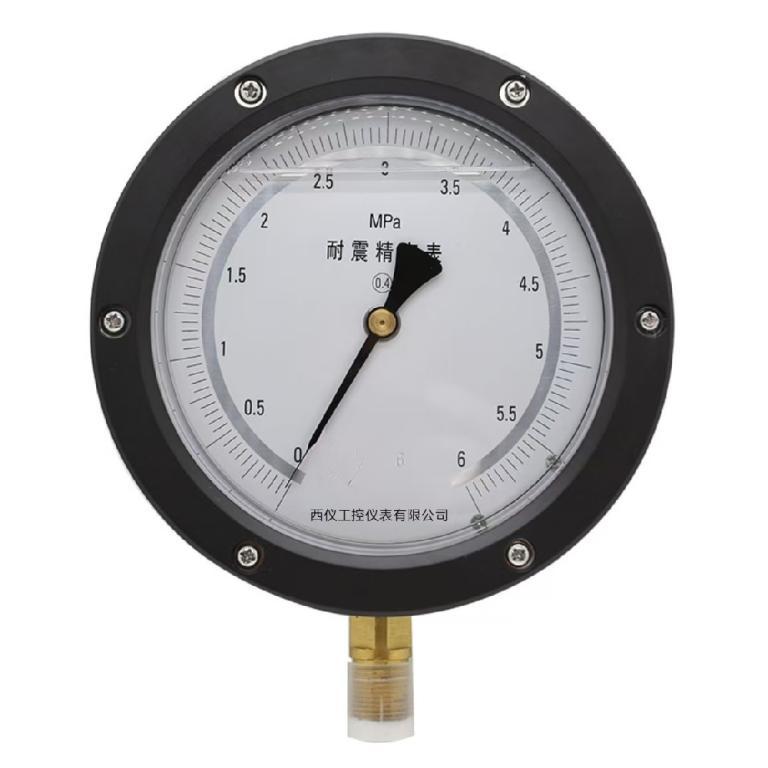
Seismic-Resistant Precision Pressure Gauge
Seismic-resistant precision pressure gauges are primarily used to calibrate industrial standard pressure gauges, and can also be employed for precise measurement of pressure and vacuum for non-corrosive, non-crystallizing, and non-solidifying media such as copper alloys and steel. They are widely used in industrial production processes, precision measurement, and scientific experiments.
The internal filling of damping fluid and matching buffer devices in seismic-resistant precision pressure gauges
provides excellent seismic resistance.
Accuracy class: 0.4.
Measurement range: 0-0.1 to 0-60 MPa
The working principle of precision pressure gauges is: when the pressure of the measured medium acts on the elastic element, it causes elastic deformation—displacement. This displacement is amplified by the transmission mechanism via a pull rod and indicated by the indicating device to show the measured pressure.
Precision pressure gauges are classified by accuracy: 0.25%, 0.4%
Technical Parameters
Main technical indicators:
○ Precision pressure gauge measurement range, accuracy class, and features
Model Spring Tube Material Measurement Range (MPa) Accuracy Class Structural Features
YB-150A Tin Phosphor Bronze
Chromium Vanadium Steel 0-0.1; 0-0.16; 0-0.25
; 0-0.4; 0-0.6; 0-1; 0-1.6;
0-2.5; 0-4; 0-6; 0-10;
0-16; 0-25; 0-40; 0-60 0.4 Mirror Surface
YB-150B 0.25 Mirror Surface with Zero Adjustment
○ Operating environmental conditions for precision pressure gauges: 5 to 40°C, relative humidity not exceeding 80%, with no impact on accurate readings from environmental vibration or pressure source fluctuations.
○ Temperature influence on precision pressure gauges: If the operating environment temperature deviates from 20±3°C (Type A) or 20±2°C (Type B), a temperature additional error of 0.4%/10°C must be considered.
○ Weight of precision pressure gauges: 1 kg (Type A) 1.4 kg (Type B)
Feature Parameters
● HQYB150 medium-pressure precision pressure gauges use German-imported spring tube components.
● Measurement range starts from 0.1 MPa up to 60 MPa.
● Pressure transmission components use silver brazing technology.
● The dial displays MPa scale values for direct reading.
● Accuracy classes: 0.25%, 0.4%.
● Double-layer mirror dial.
● Equipped with a dial zero adjustment device.
● Iron spray-coated case.
● Copper alloy internal mechanism components.
● Measurement range: -0.1 to 60 MPa. Outline dimension diagram.
Measurement Range Classification
Precision pressure gauge measurement range classification:
1. Micro-pressure gauges (instruments with an upper measurement limit less than 0.1 MPa).
2. Low-pressure gauges (instruments with an upper measurement limit from 0.1 MPa [including 0.1 MPa] to 6 MPa [including 6 MPa]).
3. Medium-pressure gauges (instruments with an upper measurement limit from 10 MPa [including 10 MPa] to 60 MPa [including 60 MPa]).
4. High-pressure gauges (instruments with an upper measurement limit greater than 60 MPa to 160 MPa [including 160 MPa]).
5. Ultra-high-pressure gauges (instruments with an upper measurement limit greater than 160 MPa).
Uses and Components
1. Composed of a measurement system, indicating part, and case part.
2. Measurement system—consists of a connector, spring tube, and gear transmission mechanism.
3. Under the pressure of the measured medium, the end (free end) of the spring tube correspondingly produces displacement, driving the sector gear in the mechanism via a link rod to generate angular displacement, causing the gear shaft to deflect—transmitted to the indicating part.
4. Indicating part—comprises a dial, mirror surface (YB-201 type without mirror surface), and pointer. The pointer indicates the pressure value of the measured medium on the dial corresponding to the deflection value of the gear shaft.
5. Case part—consists of a cover, watch glass, and housing. The lower end of the cover is equipped with a zero adjustment device to maintain zero value and reading accuracy.
Post-Use Calibration
Basic requirements for calibration: Calibration should meet the following basic requirements:
1) Environmental conditions: If calibration is performed in a calibration (verification) laboratory, the environmental conditions must meet the laboratory's requirements for temperature, humidity, etc. If calibration is conducted on-site, the environmental conditions should meet the conditions required for the instrument's field use.
2) Instruments: The error limit of the standard instrument used for calibration should be 1/3 to 1/10 of the error limit of the instrument being calibrated.
3) Personnel: Although calibration differs from verification, personnel performing calibration should also undergo effective assessment and obtain corresponding qualification certificates. Only certified personnel can issue calibration certificates and reports, and only such certificates and reports are considered valid.
Tire pressure gauge calibration can be done at local metrology institutes or third-party calibration units, such as Shanghai Metrology Institute, Guangdong Metrology Institute, Suzhou Metrology Calibration Network, etc., provided they have nationally issued CNAS metrology qualifications.
| Business Phone | |
| Contact Number 1 | (029) 8102-8005 |
| Contact Number 2 | (029) 8113-6005 |
| Business Consultation | 180 9252 2930 |
| Product Service | 135 7149 5999 |
| Technical Support | 139 9190 0175 |
| Industry Category | Instruments & Meters/Pressure Instruments/Other Pressure Instruments |
|---|---|
| Product Category | |
| Brand: | 西仪工控 |
| Spec: | |
| Origin: | 116101 |


