


Double-layer polycarbonate sheet
Contact Info
- Add:中国(河南)自贸试验区, Zip: 450000
- Contact: 孙经理
- Tel:0371-22025855
- Email:yongxinbanye@163.com
Other Products


How to distinguish the quality of polycarbonate sheets?
Polycarbonate sheets have become one of the preferred materials for greenhouse coverings due to their long service life, excellent thermal insulation, and strong heat resistance. However, many flower producers know little about their properties when purchasing polycarbonate sheets and rely solely on sensory perception, price, or supplier recommendations for selection. Quality cannot be judged merely by sensory evaluation; one common misconception among users is incorrect selection methods. "Many users choose polycarbonate sheets by pinching the board or weighing it, believing that a good sheet must be heavier and not easily dented. This is actually a major misunderstanding." Load-bearing capacity is an important indicator of polycarbonate sheet quality, which depends not only on thickness and hardness but also on raw materials and manufacturing processes. Therefore, conclusions should not be drawn based solely on hardness and thickness.
First, it is essential to understand the raw materials used in polycarbonate sheet production. The commonly used polycarbonate sheets are polycarbonate hollow sheets, also known as PC sheets. The raw materials for production should ideally be new, but some manufacturers add a portion of recycled materials to reduce costs, while others even use entirely recycled materials. Due to the higher impurity and dust content in recycled materials, transparency is lower. Thus, sheets made with recycled materials are significantly inferior in transparency and durability compared to those made entirely from new materials.
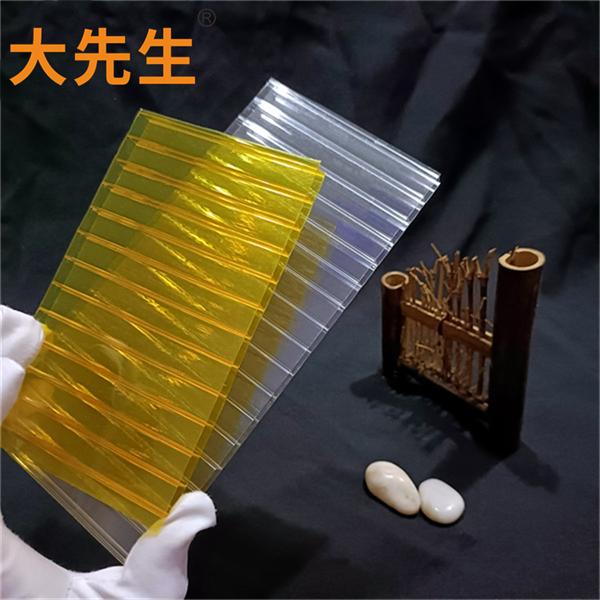
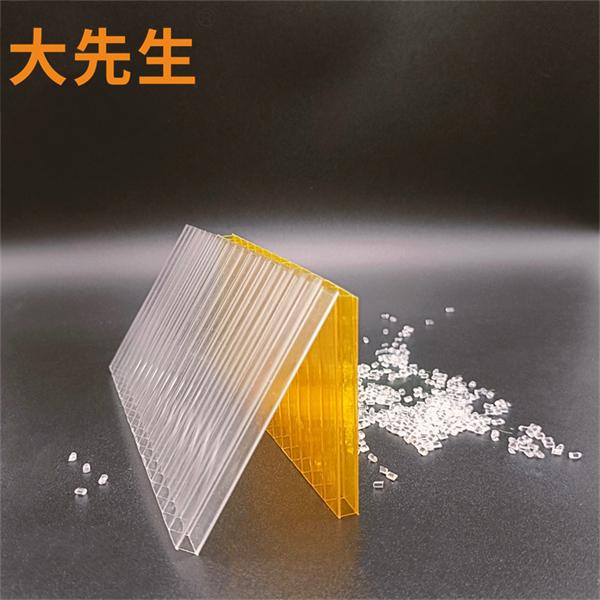
Polycarbonate Sheet Product Characteristics:
(1) Light Transmittance: PC sheets can achieve up to 89% light transmittance, comparable to glass. UV-coated sheets resist yellowing, fogging, and poor transmittance when exposed to sunlight. After ten years, the light transmittance loss is about 10%, while PVC loses 15–20%, and fiberglass loses 12–20%.
(2) Impact Resistance: The impact strength is 250–300 times that of ordinary glass, about 30 times that of acrylic sheets of the same thickness, and 2–20 times that of tempered glass. It is known as "unbreakable glass" and "sounding steel."
(3) UV Protection: One side of the PC sheet is co-extruded with an anti-UV coating, while the other side has anti-condensation treatment, combining UV resistance, thermal insulation, and anti-fogging functions. It blocks ultraviolet rays, making it suitable for protecting valuable artworks and exhibits from UV damage.
(4) Lightweight: With a specific gravity about half that of glass, it reduces transportation, handling, installation, and support frame costs.
(5) Flame Retardancy: According to the GB50222—95 standard, PC sheets are classified as flame-retardant (B1 grade). The self-ignition point of PC sheets is about 580°C, and they self-extinguish after removal from fire. They do not produce toxic gases when burning and do not contribute to the spread of flames.
(6) Bendability: Can be cold-bent on-site according to design drawings to form arches, semi-circular roofs, and windows. The minimum cold-bending radius is about 175 times the sheet thickness. Hot bending is also possible.
(7) Sound Insulation: PC sheets provide significant sound insulation, outperforming glass and acrylic sheets of the same thickness. Under identical thickness conditions, PC sheets improve sound insulation by 5–9 dB compared to glass. They are the material of choice for highway sound barriers.
(8) Energy Efficiency: Cool in summer and warm in winter, PC sheets have a lower thermal conductivity (K-value) than ordinary glass and other plastics. Their thermal insulation is 7–25% higher than that of glass, with up to 49% heat insulation. This significantly reduces heat loss, making them ideal for buildings with heating systems.
(9) Temperature Adaptability: PC sheets do not become brittle at -40°C and do not deform at 125°C. Their mechanical and physical properties remain largely unchanged even in harsh environments.
(10) Weather Resistance: PC sheets maintain stable physical properties within a temperature range of -40°C to 120°C. After 4,000 hours of artificial weathering tests, the yellowing index is 2, and the light transmittance reduction is about 0.6%.
(11) Anti-Condensation: At an outdoor temperature of 0°C and an indoor temperature of 23°C with relative humidity below 80%, the inner surface of the material does not condense. Condensation flows along the surface without dripping.
Yongxin PC structural sheet categories: General-purpose polycarbonate sheets (single-layer), single (double) sided UV-resistant polycarbonate sheets, textured sheets, frosted sheets, transparent sound barrier panels, scratch-resistant sheets, corrugated sheets, general-purpose multi-wall sheets, single (double) sided UV-resistant multi-wall sheets, crystal-clear sheets, anti-drip multi-wall sheets, easy-clean multi-wall sheets, anti-drip + easy-clean multi-wall sheets, multi-wall sheets, multi-layer multi-wall sheets, and PC tiles. PC structural sheet varieties: General-purpose single-layer sheets, impact-resistant sheets, transparent sound barrier panels, scratch-resistant sheets, and weather-resistant multi-wall sheets. Products are mainly used for ceilings in various buildings, daylighting greenhouses, highways, railway sound barriers, thermoformed skylight domes, etc.
| Industry Category | Chemicals/Chemical Intermediates/Intermediate Compounds |
|---|---|
| Product Category | |
| Brand: | 大先生 |
| Spec: | 2.1*6 |
| Stock: | 500 |
| Manufacturer: | 定制生产 |
| Origin: | 1141 |


