


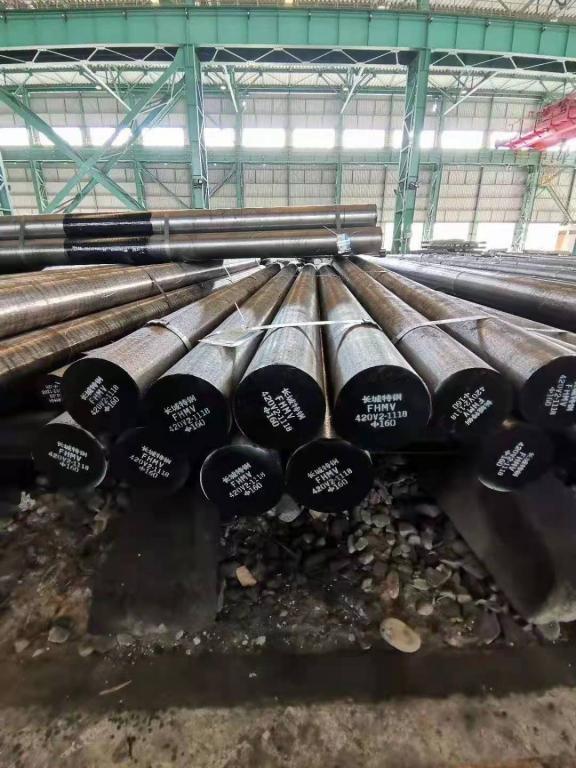
High-standard special steel for straightening rolls FHMV, special steel for support rolls FHCTZCG01.
Contact Info
- Add:枫泾工业园建安路61号, Zip: 201610
- Contact: 李小姐
- Tel:13918666153
- Email:zgfhgy@163.com
Other Products

Electroslag (casting) is a secondary refining technology that integrates secondary refining of molten steel with directional solidification in a comprehensive metallurgical casting process. Its principle involves the use of electric current passing through a liquid slag pool, where the resistance heat melts the metal electrode. The molten metal gathers into droplets, which fall through the slag layer into the metal bath, and then crystallize and solidify into an ingot in a water-cooled mold.
The refining process, which involves casting or forging steel smelted in open hearth, converter, electric arc, or induction furnaces into electrodes and then performing secondary remelting using slag resistance heat, is abbreviated in English as ESR. The United States first proposed the principle of this refining method in the 1940s. Subsequently, the Soviet Union and the United States successively established industrial-scale electroslag furnaces. By the mid-1960s, due to the development of industries such as aviation, aerospace, electronics, and atomic energy, electroslag remelting experienced rapid growth in the Soviet Union, Western Europe, and the United States. The varieties produced include: high-quality alloy steel, high-temperature alloys, precision alloys, corrosion-resistant alloys, as well as non-ferrous metal alloys such as aluminum, copper, titanium, and silver. By 1980, the global production capacity for electroslag remelted steel had exceeded 1.2 million tons.
Inside a copper water-cooled mold, molten slag is contained, with one end of the consumable electrode inserted into the slag. The consumable electrode, slag pool, metal bath, ingot, and bottom water tank form a circuit through short-network conductors and a transformer. During electrification, the slag pool releases Joule heat, gradually melting the tip of the consumable electrode. The molten metal gathers into droplets, passes through the slag pool, falls into the mold, and forms a metal bath. Under water cooling, it rapidly solidifies into an ingot. During the droplet formation stage at the electrode tip and the stage where droplets fall through the slag pool, full contact between steel and slag occurs, allowing non-metallic inclusions in the steel to be absorbed by the slag. Harmful elements in the steel (sulfur, lead, antimony, bismuth, tin) are effectively removed through steel-slag reactions and high-temperature volatilization. The liquid metal, covered by the slag pool, is largely protected from re-oxidation. Since melting, refining, and solidification occur within the copper water-cooled mold, contamination of the steel by refractory materials is eliminated. Before the ingot solidifies, a metal bath and slag pool above it provide thermal insulation and feeding, ensuring the denseness of the ingot. The rising slag pool forms a thin slag skin on the inner wall of the mold, which not only results in a smooth ingot surface but also provides insulation and thermal barrier, directing more heat downward and facilitating directional solidification of the ingot from bottom to top. Due to these reasons, the quality and performance of ingots produced by electroslag remelting are improved. The low-temperature, room-temperature, and high-temperature plasticity and impact toughness of alloy steels are enhanced, extending the service life of steel products.
| Industry Category | Metallurgy & Minerals |
|---|---|
| Product Category | |
| Brand: | 长城特钢 |
| Spec: | 齐全 |
| Stock: | 5012 |
| Manufacturer: | |
| Origin: | China / Shanghai / Jinshanqu |


