


Laboratory vacuum synthesis reactor
Contact Info
- No.4285 Shendu Highway, Pujiang Town, 200000
- 胡工
- 18001633556
- 15000845544@163.com
Laboratory Synthetic Reaction Kettle
Product Introduction
Laboratory Vacuum Synthetic Reaction Kettle
It can be customized for dispersion, mixing, emulsification, homogenization and dissolution. Under vacuum or pressure conditions, the entire reaction process of stirring, homogenization, emulsification, dispersion, mixing and other operations on materials can be observed through glass.
It can simultaneously measure the temperature, pressure, viscosity, PH, etc. of materials. It can also heat or cool materials.
Product Features
1) The homogenization and emulsification device of this machine can reach the bottom of the kettle, and internal circulation emulsification can be realized by using the emulsification head. With the combination of high-speed emulsification device and slow-speed scraping function, raw materials will form a strong circulating vortex, with no dead corners. The product can be fully mixed, emulsified, dispersed and homogenized, forming a good uniform molecular structure. This type of emulsification system has better emulsification effect than traditional ones.
2) The interlayer structure can directly perform heating and cooling functions. When cooling, there is a spiral guide plate inside to make the material cool more fully.
3) The vane vacuum pump is used for material suction, saving manpower. Vacuum feeding is adopted, especially for powder materials, which avoids dust flying when sucked by vacuum. The entire process is carried out under vacuum conditions, preventing bubbles from generating after high-speed stirring of materials, and meeting hygienic and aseptic requirements. It can also be used for degassing, making the product structure more compact and glossy, and achieving a longer shelf life. The water-sealed pump will not produce oil and gas, and is suitable for GMP plant specifications.
4) The scraper can be disassembled and assembled without tools, making cleaning and maintenance work convenient.
5) The lid is equipped with a waterproof and dustproof floodlight and a sight glass, making it convenient to observe the production situation.
6) This machine is equipped with safety protection devices, such as vacuum safety device, three-phase power safety device, interlayer pressure safety valve, emergency stop button, etc., to ensure operational safety.
7) This unit is all manufactured in accordance with GMP requirements, and is currently a domestic production equipment for shampoo and care products.
Application Scope
It is applied in industries such as pharmaceuticals, cosmetics, lithium batteries, and adhesives, and is an ideal choice for laboratories and pilot tests.
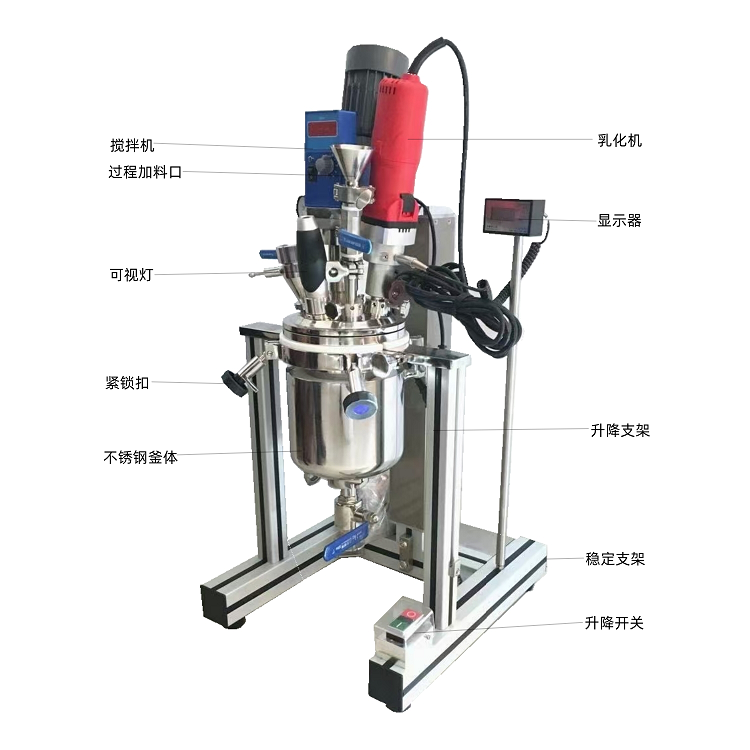
Product Parameters
Model---YK-1L YK-2L YK-5L YK-10L
Stirring speed range---50-500rpm
Vacuum degree----0.1-0mpa
Lifting method---Manual balance type/Electric type
Standard homogenization emulsifier---Y25/25G
Stirring paddle type---Wall-scraping type
Optional stirring paddle---Anchor type/Dissolution type/Blade type
Reaction kettle---Glass reaction kettle/Stainless steel reaction kettle
Material contact part material---SUS304/SUS316L/PTFE
Equipment size (mm)---400*390*780
Working Principle: The high-shear dispersion and homogenization emulsifier for glass forms comprehensive kinetic energy effects such as high-frequency, strong circumferential tangential speed, and angular speed through the high-speed and stable rotation of the rotor; under the action of the stator, strong and reciprocating hydraulic shear, friction, centrifugal extrusion, and liquid flow collision are formed in the reasonable narrow gap between the stator and rotor. The material circulates in the container through the above working process to obtain the product. Due to the high tangential speed generated by the high-speed rotation of the rotor and the strong kinetic energy brought by high-frequency mechanical effects, the material is subjected to strong mechanical and hydraulic shear, centrifugal extrusion, liquid layer friction, impact tearing, turbulence and other comprehensive effects in the narrow gap between the stator and rotor, forming a suspension (solid/liquid), emulsion (liquid/liquid) and foam (gas/liquid). The laboratory emulsifier is a device that efficiently, quickly and uniformly introduces one or more phases (liquid, solid, gas) into another immiscible continuous phase (usually liquid). Under normal circumstances, each phase is immiscible. When external energy is input, the two materials are recombined into a uniform phase. The laboratory emulsifier enables the immiscible solid phase, liquid phase and gas phase to be uniformly and finely dispersed and emulsified instantly under the combined action of corresponding mature processes and appropriate additives, and after high-frequency circulation, stable high-quality products are obtained.
Equipped with working heads of different specifications, it is designed to meet different experimental needs. Its distinctive features and functions make it an ideal equipment for scientific research, product development, quality control and production process applications in medical institutions, biological research, hygiene products, cosmetics, food processing, universities and colleges, etc.
Applicable Industry Scope:
Food: Aloe vera, pineapple, fruit tea, sesame, ice cream, mooncake filling, cream, jam, juice, soybeans, soybean paste, red bean paste, peanut milk, protein milk, soy milk, dairy products, malted milk, essence, various beverages, etc.
Chemical: Paint, pigment, dye, coating, lubricating oil, grease, diesel oil, petroleum catalyst, emulsified asphalt, adhesive, detergent, plastic, FRP, leather.
Daily use: Toothpaste, detergent, shampoo, shoe polish, cosmetics, bath gel, soap, balm, etc.
Pharmaceutical: Various syrups, nutrient solutions, paste preparations, biological products, pollen, royal jelly, various ointments,
Construction: Various coatings, including interior and exterior wall coatings, anticorrosive and waterproof coatings, cold porcelain coatings, multicolor coatings, ceramic glazes, etc.
Papermaking: Pulp, adhesive, rosin emulsification, papermaking additives, resin emulsification, etc.
Pesticide: Fungicide, seed coating agent, herbicide, pesticide emulsifiable concentrate, chemical fertilizer, biochemical pesticide, biological pesticide, etc.
Other: Textile industry, coal flotation agent, rare earth, nanomaterial dispersion and depolymerization, reaction extraction and other fields.
Parameter Configuration as Follows: | ||||
Brand & Model: | YK-1L | YK-2L | YK-5L | YK-10L |
Power Supply: | 220V/50Hz | 220V/50Hz | 220V/50Hz | 220V/50Hz |
Minimum Stirring Volume: | 100ml | 100ml | 500ml | 500ml |
Minimum Emulsification Volume: | 400ml | 800ml | 2000ml | 5000ml |
Maximum Processing Volume: | 1000ml | 2000ml | 5000ml | 10000ml |
Maximum Working Temperature: | 120° | 120° | 300° (Glass kettle body 120°) | 300° (Glass kettle body 120°) |
Temperature Control Method: | Water bath external circulation constant temperature | Water bath external circulation constant temperature | Water bath external circulation constant temperature | Water bath external circulation constant temperature |
Vacuum Level: | -0.095Mpa | -0.095Mpa | -0.095Mpa | -0.095Mpa |
Maximum Processing Viscosity: | 70000CP | 70000CP | 70000CP | 70000CP |
Mixer Power: | 120W | 150W | 150W | 300W |
Mixer Speed: | 0~200rpm | 0~200rpm | 0~200rpm | 0-200rpm |
Paddle Configuration: | Anchor-type wall-scraping stirring paddle, PTFE scraper | Anchor-type wall-scraping stirring paddle, PTFE scraper | Anchor-type wall-scraping stirring paddle, PTFE scraper | Anchor-type wall-scraping stirring paddle, PTFE scraper |
Shear Emulsifier Power: | 1300W | 1300W | 1300W | Dual 1300W |
Shear Emulsifier Speed: | 8000-30000 rpm | 8000-30000 rpm | 8000-30000 rpm | 8000-30000 rpm |
Shear Emulsification Head Specification: | 25DG | 25DG | 25DG | Dual 25DG |
Reaction Kettle Lid Openings: | Stirring opening + feeding opening + temperature measuring opening + vacuum opening + emulsifier opening + spare opening | Stirring opening + feeding opening + temperature measuring opening + vacuum opening + emulsifier opening + spare opening | Stirring opening + feeding opening + temperature measuring opening + vacuum opening + emulsifier opening + spare opening | Stirring opening + feeding opening + temperature measuring opening + vacuum opening + emulsifier opening + spare opening |
Support Lifting Method: | Electric lifting | Electric lifting | Electric lifting | Electric lifting |
Lifting Stroke: | 450mm | 450mm | 450mm | 450mm |
Kettle Body Material: | Double-layer high borosilicate glass | Double-layer high borosilicate glass | Double-layer high borosilicate glass | Double-layer high borosilicate glass |
Vacuum Opening Outer Diameter: | 12mm | 12mm | 12mm | 12mm |
Glass Container Interlayer Inlet & Outlet: | 12mm | 12mm | 12mm | 12mm |
Discharge Method: | Discharge via discharge valve / Tipping for discharge | Discharge via discharge valve / Tipping for discharge | Discharge via discharge valve / Tipping for discharge | Discharge via discharge valve / Tipping for discharge |
Material Contact Part Material: | SUS316L stainless steel + silicon borate glass interlayer container | SUS316L stainless steel + silicon borate glass interlayer container | SUS316L stainless steel PTFE | SUS316L stainless steel PTFE |
Outer Packaging Size: | 600×400×1300 | 600×400×1300 | 600×400×1300 | 600×400×1300 |
Weight: | 35KG | 35KG | 35KG | ~65kg |
Packaging Method: | Wooden box packaging | Wooden box packaging | Wooden box packaging | Wooden box packaging |
| Chemicals/Reaction Equipment/Reactors | |


