


T-slot workbench
Contact Info
- Add:North Meng Village, West of Jiaohe Town, Zip: 062151
- Contact: 小赵
- Tel:0317-8250620
- Email:hbbzjx@163.com
Other Products


The T-slot workbench from Beizhong Company, also known as the T-slot surface plate, is a type of industrial measuring tool primarily used for securing workpieces. It is a cast iron workbench employed by fitters for equipment debugging, assembly, and maintenance.
Made from high-strength cast iron HT200-300, the working surface hardness ranges from HB170-240. After two artificial treatments (artificial annealing at 600-700 degrees or natural aging for 2-3 years), the product ensures stable accuracy and excellent wear resistance.
Available in sizes from 100*100mm to 3000*8000mm (custom specifications can also be produced based on actual requirements) 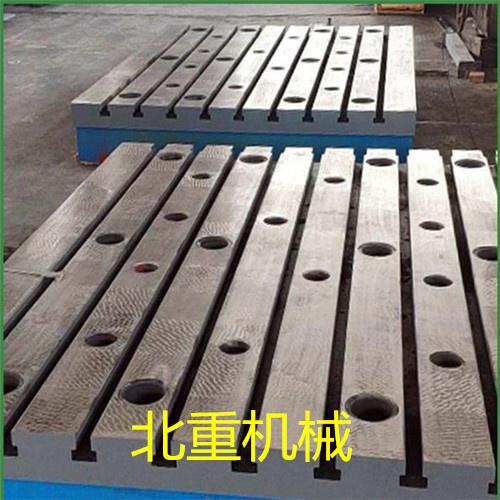
Complies with national standard metrological verification regulations, categorized into four grades: 0, 1, 2, and 3 (lower values indicate higher precision).
The T-slot workbench surface should be free from rust marks, scratches, impact damage, and other surface defects that could affect its use.
The T-slot workbench surface should not have casting defects such as sand holes, air holes, cracks, slag inclusions, or shrinkage cavities. All casting surfaces must be thoroughly cleaned of molding sand, be flat, have firmly applied paint, and all sharp edges should be rounded off.
On the relative sides of the T-slot workbench, there should be provisions for installing handles or lifting points, threaded holes, or cylindrical holes. When designing lifting points, minimize deformation caused by lifting.
The T-slot surface plate must undergo stabilization treatment and demagnetization.
The perpendicular tolerance between the working surface and the sides, as well as between adjacent sides, is Grade 12 (as specified in GB1184-80 "Geometric Tolerances").
The hardness of the T-slot surface plate working surface should be between HB170-220 or 187-255.
Main inspection items for T-slot surface plates:
1. Material and surface hardness. 2. Geometric tolerances, including nominal dimensions and perpendicularity tolerance. 3. Appearance. 4. Flatness. 5. Contact spots. 6. Surface fluctuation. 7. Allowable deflection value of the working surface. 8. Surface roughness.
Precision parameters:
Grade 3 surface plates do not specify contact spot requirements. Grade 1 surface plates require at least 20 contact spots per 25*25mm area. Grade 2 surface plates require at least 12 contact spots per 25*25mm area.
Usage precautions for T-slot workbenches:
During production, T-slot platforms may have deviations from the theoretical weight. It is important to ensure that these deviations do not affect the platform's usability. Generally, the design of cast iron surface plates should account for casting and machining errors. The weight deviation of cast iron surface plates should not exceed 10%. If it exceeds 10%, further quality assessment is necessary to determine if the cast iron surface plate can be put into use.
Some product defects may occur during the production of T-slot platforms. As long as correct methods are used, these can be remedied through processing. Defects on the working surface of cast iron surface plates are critical and cannot be overlooked. Main defects include air holes, sand holes, sand inclusions, shrinkage cavities, etc. Therefore, repairs to cast iron surface plate defects must strictly follow processing requirements.
| Industry Category | Others |
|---|---|
| Product Category | |
| Brand: | 北重机械 |
| Spec: | 可定制 |
| Manufacturer: | 北重机械加工厂家 |
| Origin: | 111309 |


