


Large Test Iron Plate 2000×4000mm
Contact Info
- Add:, Zip: 061000
- Contact: 谢佳宁
- Tel:15350773479
- Email:3622313939@qq.com
Other Products


Analysis of Test Bench Base Strength and Wear Resistance: How to Extend Service Life?
The test bench base is a fundamental supporting component for various industrial tests and scientific research experiments. Its strength and wear resistance directly determine the stability of the test equipment, the accuracy of test data, and the overall service life of the equipment. Under complex working conditions such as long-term heavy load bearing, high-frequency vibration, and chemical corrosion, insufficient strength of the base can easily lead to deformation and fracture, while poor wear resistance can cause surface wear and reduced precision, not only increasing maintenance costs but also potentially causing safety hazards. This article will delve into the core aspects of the strength and wear resistance of test bench bases and provide practical solutions to extend their service life.
I. Core Support for Strength Performance: Material and Structural Design
The strength of a test bench base is not a single indicator but the result of the combined effects of material properties and structural design. Its core lies in the ability to resist static loads, dynamic impacts, and long-term stress. Key Material Selection: Currently, the mainstream materials for high-strength bases are gray cast iron (e.g., HT300, HT350) and ductile cast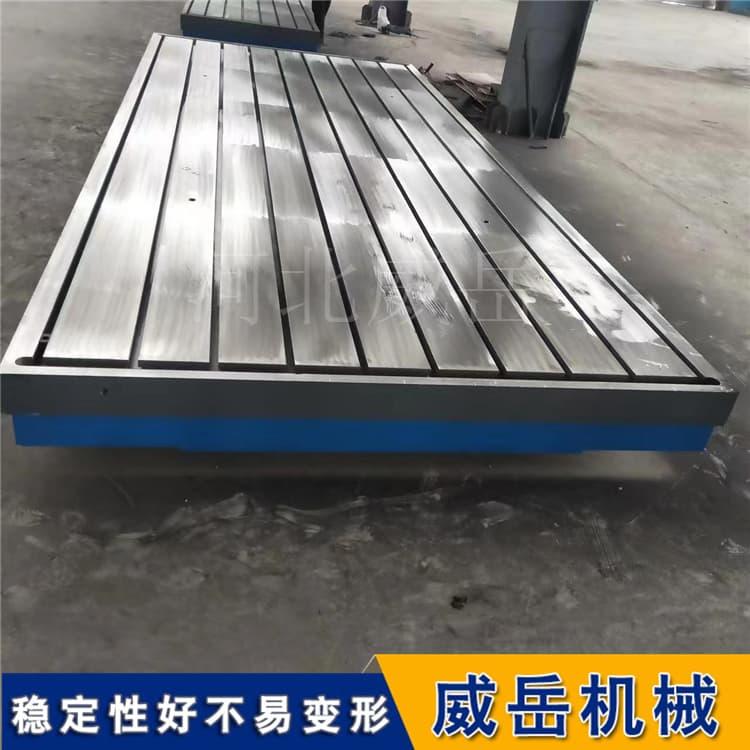
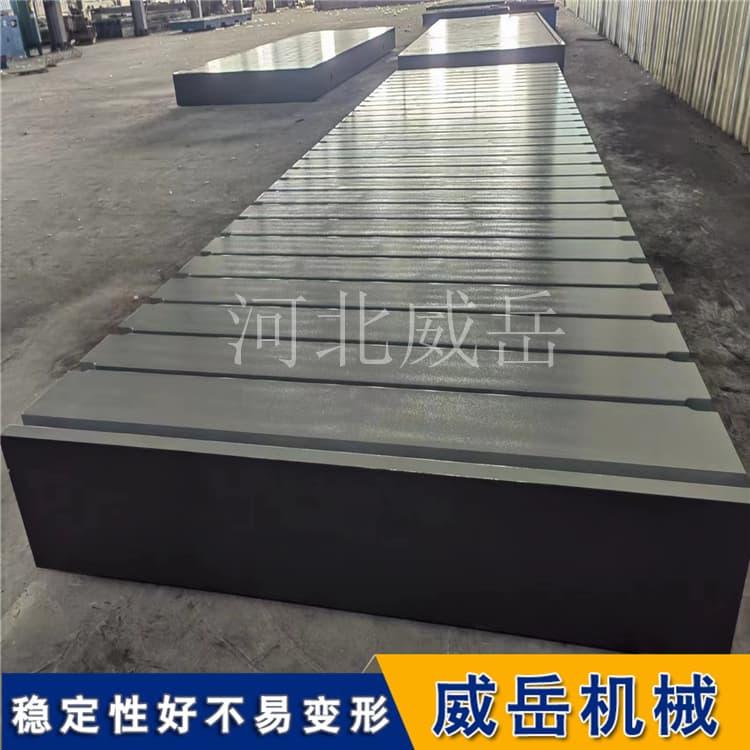
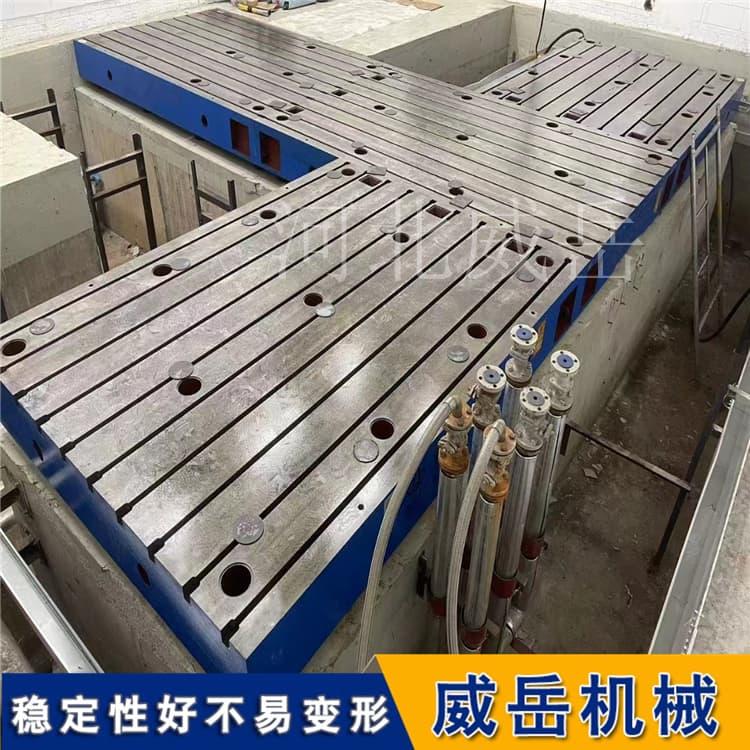 iron (e.g., QT500-7, QT600-3). The flake graphite in gray cast iron disperses stress, with compressive strength reaching 300-400 MPa, making it suitable for scenarios primarily involving static load bearing. Ductile cast iron, optimized with its spherical graphite morphology, achieves tensile strength above 500 MPa, with impact toughness 3-5 times that of gray cast iron, making it more suitable for test benches subjected to high-frequency vibration or sudden impacts (e.g., automotive crash test bases). Additionally, low-alloy cast iron (with added elements such as chromium and molybdenum) is used in some high-precision scenarios, increasing high-temperature strength by over 20% to adapt to high-low temperature cycle test environments.
Structural Design Reinforcement: A rational structure allows the material strength to be fully utilized. The base adopts a "thick bottom + grid rib plate" design, with a bottom thickness of no less than 200 mm and rib plate spacing controlled between 300-500 mm, forming a uniform stress dispersion network. For example, for a base supporting a 10t material test bench, after optimizing the rib plate layout through ANSYS simulation, the stress value decreased from 250 MPa to 180 MPa, well below the yield strength of HT300 (200 MPa), avoiding cracking caused by local stress concentration. Additionally, rounded edges (radius ≥ 50 mm) are used to reduce stress concentration at sharp corners, further enhancing overall deformation resistance.
II. Determinants of Wear Resistance: Surface Treatment and Friction Coefficient Control
Wear on the base primarily comes from friction during workpiece placement, equipment movement, and environmental corrosion. The core of wear resistance lies in reducing the surface wear rate and maintaining long-term precision.
Improving Surface Hardness: Enhancing surface hardness through heat treatment processes is key to improving wear resistance. Gray cast iron bases can undergo "medium-frequency quenching" to increase surface hardness from 180 HBW to 45-55 HRC at a depth of 3-5 mm, improving wear resistance by 3-4 times. Ductile cast iron bases are suitable for "normalizing + tempering" processes, stabilizing surface hardness at 220-280 HBW while maintaining core toughness to avoid embrittlement and cracking.
Surface Roughness and Lubrication: Low surface roughness reduces the friction coefficient. The working surface of the base should be precision-ground to control roughness at Ra ≤ 1.6 μm, reducing friction resistance between the workpiece and the base. For bases with frequently moving equipment, molybdenum disulfide grease (temperature-resistant from -40°C to 300°C) can be applied to the contact surface, reducing the friction coefficient from 0.3 to 0.15 and lowering the wear rate by over 50%.
The strength and wear resistance of a test bench base are the core guarantees for its long-term stable operation. Material selection and structural design determine the performance ceiling, while scientific use and maintenance fully unleash its potential. By selecting cast iron such as HT300 or higher, optimizing rib plate structures to enhance strength, adopting quenching + precision grinding processes to improve wear resistance, and combining load control, environmental management, and regular maintenance, the service life of the base can be extended by over 50%, significantly reducing equipment maintenance costs. In practical applications, solutions should be optimized based on specific test scenarios (e.g., static load bearing, dynamic impact, corrosive environments) to ensure the base remains in optimal working condition, providing reliable foundational support for various tests. As industrial test precision requirements increase, the continuous optimization of base performance will become a key factor in improving test efficiency and data reliability.
Weiyue Machinery, Ms. Xie, 15350773479
| Industry Category | Chemicals/Chemical Intermediates/Intermediate Compounds |
|---|---|
| Product Category | |
| Brand: | 河北威岳 |
| Spec: | 2000*4000 |
| Manufacturer: | 河北威岳机械 |
| Origin: | 111309 |


