


Cast Iron T-Slot Platform
Contact Info
- Add:, Zip: 061000
- Contact: 谢佳宁
- Tel:15350773479
- Email:3622313939@qq.com
Other Products


A Brief Discussion on the Material "Cast Iron" of Large Cast Iron Platforms
Research indicates that this issue is related to the pouring temperature. When the pouring temperature exceeds 1380°C, this problem does not occur in the castings. Therefore, the pouring temperature for large cast iron platforms should be controlled at 1380°C. It is worth mentioning that altering the design of the pouring system did not eliminate this issue, so it can be attributed to low pouring temperature and the formation of iron liquid in a slightly reducing atmosphere. A common reason for excessively low pouring temperatures in large cast iron platforms is the heat dissipation during prolonged transportation and停留 of the iron liquid in open ladles before pouring. Using ladle covers with insulating materials is recommended.
Large Cast Iron Platforms and Ductile Iron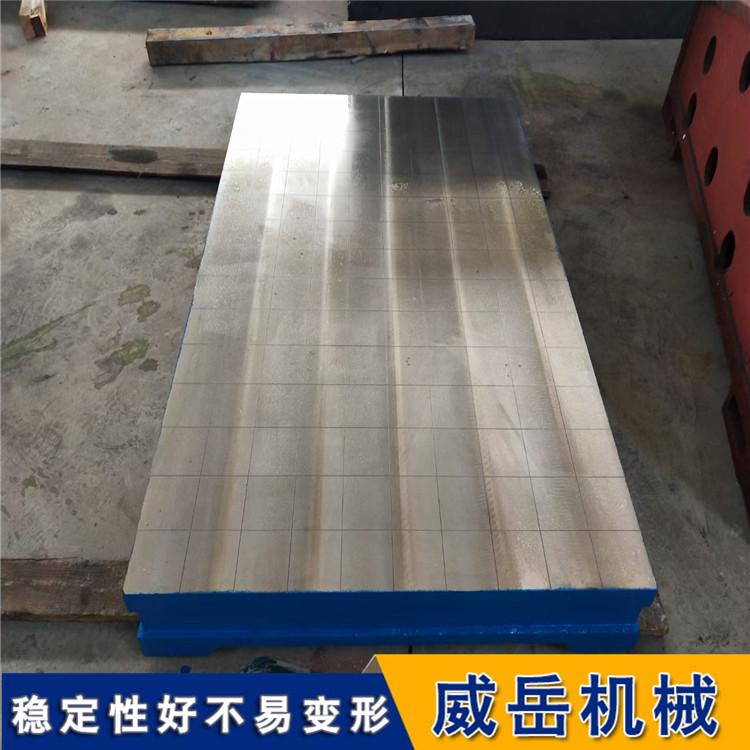 are both eutectic Fe-C alloys, with eutectic transformation being a critical stage during solidification. Although hypoeutectic cast iron, eutectic cast iron, and hypereutectic cast iron all precipitate primary austenite, during eutectic transformation, nucleation and crystallization do not rely on austenite. Instead, in large cast iron platforms, the eutectic composition of the iron liquid between the primary austenite dendrites begins solely with graphite nucleation.
Poor coating quality, inadequate venting, or even the coating itself volatilizing or releasing gases. The surface of the mold cavity for large cast iron platforms has holes or pits. When molten metal is injected, the gas in these holes or pits rapidly expands and compresses the molten metal, forming blowholes. Rust on the surface of the mold cavity that has not been thoroughly cleaned. Raw materials (sand cores) stored improperly and not preheated before use. Inadequate deoxidizers, insufficient quantities, or improper operation. The surface of the mold cavity has holes or pits. When molten metal is injected, the gas in these holes or pits rapidly expands and compresses the molten metal, forming blowholes.
Gray cast iron and ductile iron, the structures formed by eutectic transformation in large cast iron platforms, are both共生 crystals composed of graphite and austenite, but their formation methods differ. They基本上 rely on heterogeneous nucleation. The heterogeneous nuclei that support graphite precipitation in large cast iron platforms are primarily composed of various oxides, sulfides, and silicates. Due to differences in composition and processing methods among various large cast iron platforms, the actual composition of graphite nuclei also varies.
Ceramic mesh screens are effective at slag removal but can cause flow resistance and easily lead to cold shuts. Core supports that are too small, too few, or not properly positioned can cause core floating, resulting in thin walls in large cast iron platforms. Excessive thickness of coating on sand cores or molds, or accumulation of coating material, can lead to localized thin walls in castings, forming cold shuts. Sand adhered to one side of the inner wall of the jacket box, causing misalignment of the sand core during jacket box assembly. Dry sand adhered to the flatbed of the transfer cart in the large cast iron platform production line, causing sudden obstruction of sand core movement and misalignment of the upper box. Wear of taper pins, pin sleeves, or models leading to misalignment during box closing.
The heterogeneous nuclei that support graphite precipitation in large cast iron platforms undergo nucleation through the following processes: Some strong deoxidizing elements form fine oxides in the iron liquid of large cast iron platforms, primarily Al and Si, along with Mn, Ti, Zr, etc., serving as the core of the nuclei. On these fine oxides, an outer layer of (Mn, x)S sulfides forms, which acts as the heterogeneous nucleus for graphite precipitation. Its size is <5μm, generally ranging from 0.4 to 2.0μm. When cast iron is not inoculated, x in (Mn, x)S is mainly Fe, with minimal elements like Ca, Al, Ti present in the sulfides. This type of (Mn, x)S has poor compatibility with graphite, resulting in inferior graphite precipitation in large cast iron platforms.
The geometric shape of large cast iron platforms should be flat and regular, with uniform thickness of overall reinforcing ribs. Weight deviation of large cast iron platforms: During production, theoretical weight deviations may occur. According to standard requirements, weight errors generally should not exceed the specified limit to avoid affecting the use of large cast iron platforms. Platform material: HT200, with chemical composition S <0.12, P <0.15.
Weiyue Machinery, Ms. Xie 15350773479
| Industry Category | Hardware & Tools/Castings/Iron Castings |
|---|---|
| Product Category | |
| Brand: | 威岳 |
| Spec: | |
| Origin: | 111309 |


