


Cast iron surface plate
Contact Info
- Add:, Zip: 061000
- Contact: 谢佳宁
- Tel:15350773479
- Email:3622313939@qq.com
Other Products


Rational Design Concept and Proportioning of Weight Reduction Holes for Large Cast Iron Platforms with Double T-Slot
The sand core of the large cast iron platform is composed of two combined sand cores. During the core-making process of the large cast iron platform, the entire sand core is coated with water-based paint, with partial brushing. The sand core is preheated to dry the coating. Spraying and brushing may not be fully executed, leading to missed coating and resulting in sand adhesion. The pouring temperature is high, with good fluidity, low surface tension, and high dynamic pressure of the molten metal. Due to the thin-walled nature of the shell casting, the wall thickness at the thin sections of the large cast iron platform is designed to avoid cold shut defects. In the original process, the pouring temperature was relatively high.
The pouring speed for the large cast iron platform is slow, and the pouring cup is not fully filled. The sprue entrains air and inhales impurities, forming entrapped blowholes and slag holes. The small capacity of the pouring cup causes the molten metal of the large cast iron platform to form vortices, generating blowholes. The connection between the pouring cup and the pouring system of the large cast iron platform is poorly sealed, especially between the sprue and the pouring cup. Under negative pressure, sand inclusion and blowholes are easily formed. The high dust content and poor permeability of the molding sand, along with internal blockages in the negative pressure pipeline, cause distortion of the negative pressure level. This results in the negative pressure around the mold cavity being much lower than the indicated negative pressure, preventing the timely discharge of vaporized substances and leading to gas holes or surface wrinkles.
Some research has been conducted on the temperature range for crack formation in carbon steel castings. Using X-ray imaging, the temperature range for crack formation in large cast iron platforms was recorded. The carbon content of the casting, 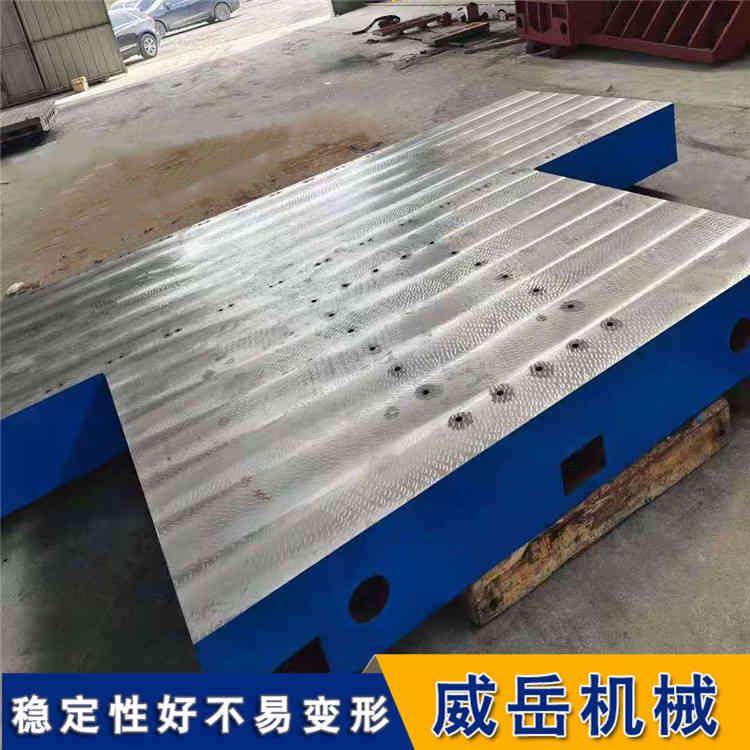 the temperature range for hot crack formation is near the solidus line. The strength and plasticity of the casting at high temperatures are relatively low, and the casting stress of the large cast iron platform is high.
Reasonable pouring process and negative pressure level. The lost foam casting process follows the principle of filling the closed sprue, avoiding sudden changes in speed, turbulence, or interruption, and certainly not allowing the sprue to be exposed. The pouring speed for the large cast iron platform, especially during the pause in hoist lifting, should strive for balance without interruption. Towards the end, the ladle should be slowly withdrawn, allowing sufficient time for slag, gas, and vaporized residues to escape. Excessive negative pressure intensifies the penetration of molten metal, leading to sand adhesion and causing a wall-adhesion effect, which is unfavorable for the adsorption of liquid foam by the coating. This generates many blowholes. Appropriate negative pressure is essential for venting and is also a measure to prevent sand adhesion. Causes of blowhole formation in large cast iron platforms: excessive addition of resin and curing agent in resin sand, high resin content, high angularity coefficient of raw sand and sand, excessively fine particle size, high ignition loss and micro-powder content, and high gas generation of the sand with low permeability. Due to damp, rusty, or oily furnace charge, humid climate, un-dried melting tools and ladles, and improper composition of molten metal,
Pouring process: The influence of pouring temperature and pouring speed on the formation of hot cracks in castings is complex. Generally, for thin-walled parts of large cast iron platforms, higher pouring temperatures and faster pouring speeds are advisable. This allows the temperature of the casting to quickly become uniform, preventing local overheating, while also enabling slower condensation of the casting, reducing shrinkage stress in the large cast iron platform, thereby minimizing or preventing hot cracks. For thick-walled parts, lower pouring temperatures and slower pouring speeds are preferable. If high pouring temperatures and fast pouring speeds are used for thick-walled parts, the shrinkage of the molten metal can easily cause hot cracks in the large cast iron platform. In severe cases, the casting may simultaneously develop hot cracks and shrinkage cavities (if both issues occur at the same location, it is referred to as shrinkage cracking).
Additionally, low clay and ash content in the molding sand can prevent the filling of sand gaps, also affecting the sand间隙. Meanwhile, the workshop produces cylinder heads in addition to large cast iron platforms, and the performance of the molding sand for large cast iron platforms is influenced by product changes. The low content of coal dust in the sand, along with poor coal dust quality, affects the sand's resistance to adhesion. The main additive for preventing sand adhesion and improving the surface finish of wet-type iron castings is coal dust. The coal dust content in the workshop sand ranges between 3.5~4. The gas generation of the sand is between 17~20 ml/g.
| Industry Category | Hardware & Tools/Castings/Iron Castings |
|---|---|
| Product Category | |
| Brand: | 威岳 |
| Spec: | 2000*4000 |
| Origin: | 111309 |


