


Motor Fatigue Test Bench
Contact Info
- Add:, Zip: 061000
- Contact: 谢佳宁
- Tel:15350773479
- Email:3622313939@qq.com
Other Products


What is a cast iron testing platform? A brief introduction
A cast iron testing platform is a fundamental tool widely used in industrial manufacturing, machining, quality inspection, and other fields. It is primarily used for measuring, inspecting, marking, assembling, and testing workpieces. Its core characteristics are high precision, high stability, and excellent wear resistance, providing a reliable reference plane for production processes. Below is a detailed introduction covering material properties, classification, application scenarios, and maintenance.
I. Material and Manufacturing Process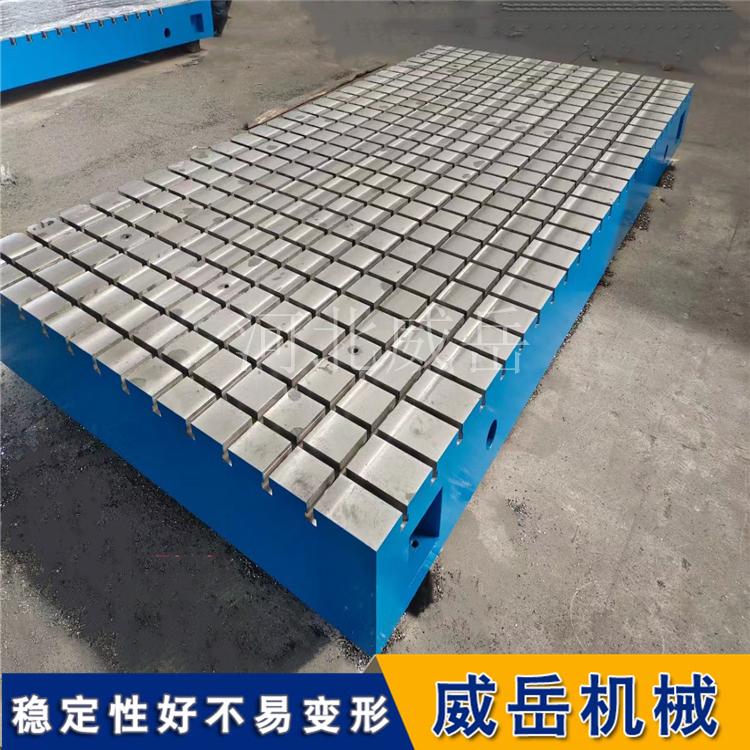
Cast iron testing platforms are typically made of HT200 or HT250 gray cast iron (i.e., high-strength cast iron), which offers the following advantages:
1. Strong stability: The graphite structure inside the cast iron absorbs vibrations, reducing deformation caused by external forces or temperature changes, and it is less prone to warping over long-term use.
2. Wear resistance and durability: After aging treatment (natural placement or artificial annealing), internal stress is significantly reduced, and surface hardness can reach HB170-240, making it suitable for inspection environments with frequent friction.
3. Good machinability: Through scraping processes, surface flatness can achieve micrometer-level precision, commonly classified into Grade 0, Grade 1, and Grade 2 (National Standard GB/T22095-2008).
The manufacturing process includes melting, casting, rough machining, aging treatment, precision machining, and scraping. Aging treatment is a critical step, requiring several months to eliminate internal stress and ensure long-term stability of the platform.
II. Main Types and Functions
Based on usage and structure, cast iron testing platforms can be categorized as follows:
1. Inspection platforms: Used for measurement, such as checking the flatness and straightness of workpieces. The surface often features grid lines to assist with positioning.
2. Marking platforms: Provide reference lines for machining, often used with tools like height gauges and scribers.
3. Assembly platforms: Serve as support surfaces for assembling large equipment, requiring higher load-bearing capacity (e.g., thickened designs or reinforced rib structures).
4. Welding platforms: Equipped with T-slots or holes on the surface to facilitate workpiece fixation, commonly used in heavy machinery manufacturing.
Dimensions vary widely, with small platforms as small as 400×600mm and large platforms spanning several meters. Custom sizes are available for special requirements.
III. Core Application Areas
1. Machinery manufacturing: Used to inspect the precision of machine tool guides, gear meshing, etc., such as flatness verification of automotive engine blocks.
2. Assembly and measurement of components like turbine blades, which require high platform flatness (up to 0.005mm/m).
3. Scientific research and education: Serve as calibration benchmarks for optical instruments and sensors in laboratories.
4. Energy equipment: Large flange assembly for wind power equipment relies on highly stable platforms.
Case studies show that a shipbuilding company used cast iron platforms to control coaxiality errors of propeller shafts within 0.02mm, significantly improving propulsion efficiency.
IV. Usage and Maintenance Guidelines
1. Installation requirements: Must be placed in a constant-temperature environment, avoiding direct sunlight. Use three-point support to adjust levelness (error ≤0.05mm/m).
2. Daily maintenance:
Wipe with anti-rust oil (e.g., N32 mechanical oil) after use to prevent surface rust.
Avoid heavy impacts or localized overheating (e.g., welding sparks).
3. Precision calibration: Regularly check flatness with electronic levels or laser interferometers. Re-scraping is necessary if deviations exceed standards.
As the "cornerstone" of industrial measurement, the performance of cast iron testing platforms directly impacts product quality. With the development of smart manufacturing, they may integrate digital sensors for real-time monitoring in the future. However, their core value—providing a stable and reliable reference plane—remains irreplaceable. Users should select the appropriate precision grade based on actual needs and focus on long-term maintenance to extend service life.
Weiyue Machinery, Ms. Xie, 15350773479
| Industry Category | Machinery & Equipment/Commercial Equipment/Display Racks |
|---|---|
| Product Category | |
| Brand: | 河北威岳 |
| Spec: | 2000*4000 |
| Manufacturer: | 河北威岳机械 |
| Origin: | 111309 |


