


Waste Heat from Flue Gas Heating Demineralized Water
Contact Info
- Add:杭州市临平区钱江经济开发区兴国路503号, Zip:
- Contact: 韩金荣
- Tel:0571-89002792
- Email:523884910@qq.com
Other Products


Work Overview:
Most boilers have an exhaust flue gas temperature above 100°C. Flue gas at this temperature is directly discharged into the atmosphere, resulting in significant heat energy loss. By utilizing the waste heat from the end flue gas of the boiler through a superconducting heat exchanger, the boiler's demineralized water is reheated, reducing heat energy loss. Through structural design of the superconducting heat exchanger, the exhaust flue gas temperature can be reduced to as low as 40°C.
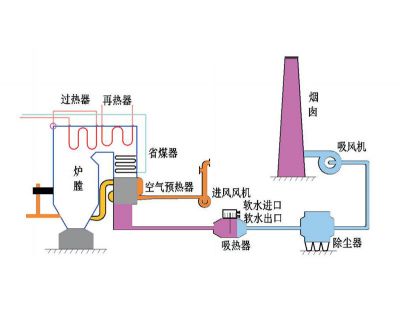
Schematic Diagram of Waste Heat Recovery Process
Utilizing waste heat from boiler exhaust flue gas, the demineralized water is heated via superconducting material heat exchange.
System Advantages:
1. This technology uses a superconducting energy saver to recover waste heat from boiler exhaust flue gas to heat soft water, thereby reducing steam consumption.
2. Compared to heat pipes, the superconducting medium does not generate non-condensable gases during long-term operation and can inhibit metal oxidation, ensuring a long service life.
3. Due to the isothermal nature of the superconducting medium, the heat absorption surface can be adjusted to avoid acid dew point corrosion in the flue gas.
4. Each superconducting tube operates independently; damage to a single tube does not affect system operation and maintenance is convenient. In contrast, traditional energy savers require system shutdown for repair if a single heat transfer tube is damaged.
5. Lowering the temperature of flue gas entering the treatment system benefits both desulfurization reactions and the operation of dust collectors.
| Industry Category | Others |
|---|---|
| Product Category | |
| Brand: | 新蓝能源 |
| Spec: | |
| Origin: | 113301 |


