


Sewage and Wastewater Series
Contact Info
- Add:宜兴市高塍镇国际环保城19栋28-29, Zip: 214214
- Contact: 宜兴市高塍镇国际环保城19栋28-29
- Tel:051087896608
- Email:yxhuanbao@126.com
Other Products


I. Overview:
Although the working principle and application scope of the YF integrated air flotation unit are basically the same as other air flotation systems, it has undergone significant structural reforms and offers the following advantages:
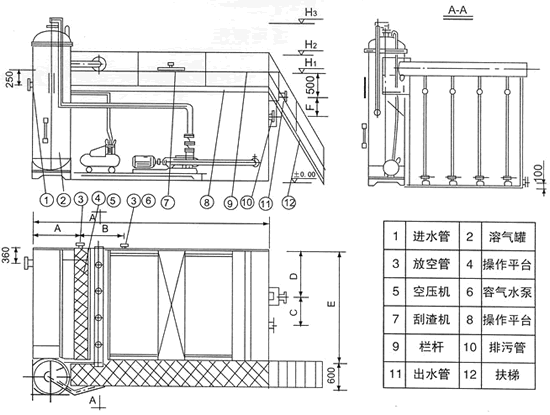
1. Equipment Integration: General air flotation systems consist of separate components such as the air flotation tank, dosing equipment, dissolved air tank, dissolved air water pump, air compressor, and sewage pump. This results in longer installation time, inconvenient management, and a large footprint. The YF air flotation unit organically combines these separate components. For sewage requiring pH adjustment, it can be put into use immediately by simply connecting the inlet and outlet pipes.
2. Automated Operation: Once the YF air flotation unit is properly debugged, it can operate automatically without the need for manual management during normal operation.
Working Principle
The working method of this equipment belongs to the pressurized dissolved air flotation method. Its working principle is as follows: Under certain conditions, a large amount of air is dissolved in water to form dissolved air water, which serves as the working medium. Through sudden decompression and rapid release, a large number of fine bubbles are generated. These bubbles adhere to the "flocs" in the wastewater after coagulation reaction, causing the flocs to float. The floating scum and oil are then removed by a dedicated scum scraping device, achieving solid-liquid separation.
Schematic Diagram
The pressurized dissolved air flotation process mainly consists of three parts: the pressurized dissolved air system, the dissolved air release system, and the air flotation separation system.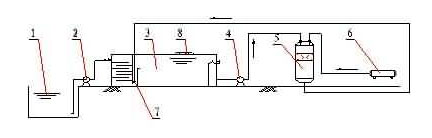
1. Wastewater tank 2. Wastewater lifting 3. Air flotation tank 4. Return pump 5. Dissolved air tank 6. Air compressor 7. Release device 8. Scum scraper
Application Scope
Solid-liquid separation: For sewage where the solid particles are very small, and the density of the particles themselves and the flocs they form is close to or less than that of water, making it difficult to achieve solid-liquid separation using sedimentation methods.
2. Liquid-liquid separation: Separation and recovery of fine oil droplets, surfactants, and various metal ions such as petroleum and organic solvents from wastewater.
3. Water supply: Can be applied to the purification of water sources with high algae content, low-temperature and low-turbidity water sources, polluted water sources, and industrial raw materials.
4. Requires higher hydraulic efficiency than gravity sedimentation.
| Industry Category | Others |
|---|---|
| Product Category | |
| Brand: | |
| Spec: |


