


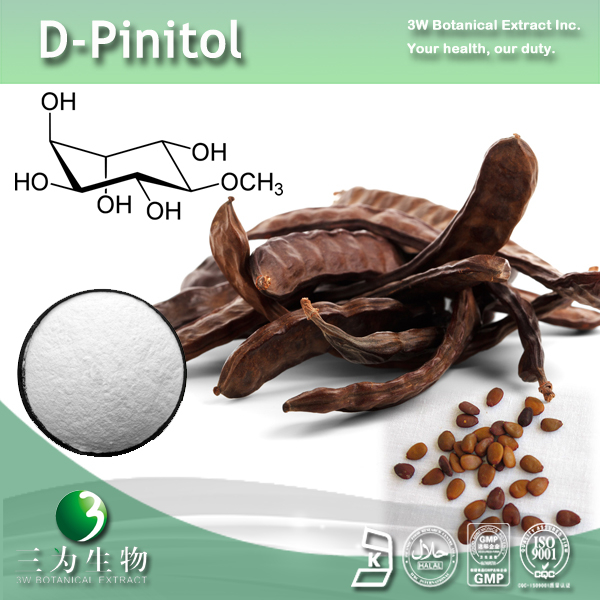
D-Pinitol
Contact Info
- Add:C401, 188 Middle Huanbao, Changsha China, Zip: 410000
- Contact: Harrison Chang
- Tel:86-731-82938995
- Email:Sales@3wbio.com
Other Products
D-Pinitol 95% HPLC
CAS#: 10284-63-6
Main Contents: D-Pinitol
Plant Resource: Ceratonia siliqua
Main Specification: 95% HPLC
Appearance: White powder
Plant Part Used: Pod
Extract Solution: Ethanol
Molecular Weight: C7H14O6
Molecular Mass: 194.18
Melting point: 179–185 °C
Solubility: Partly soluble in Ethanol
What is Carob?
Ceratonia siliqua, commonly known as the Carob tree and St John's-bread, is a species of flowering evergreen shrub or tree in the pea family, Fabaceae. It is widely cultivated for its edible legumes, and as an ornamental tree in gardens. The seed pod may be crushed and used as ersatz chocolate.
It is native to the Mediterranean region including Southern Europe, Northern Africa, the larger Mediterranean islands; to the Levant and Middle-East of Western Asia into Iran; and to the Canary Islands and Macaronesia.
What is Carob syrup Extract D-Pinitol?
The carob pod, an important fruit of the food industry in the production of concentrated syrup, is rich in potentially health-promoting phenolic compounds and sugars. Moreover, one of the important bioactive components of carob is D-pinitol, and it has some beneficial effects on human metabolism. The optimum conditions for extraction of D-pinitol and total phenolic compounds (TPC) from cultivated and wild types of carob pods were determined using response surface methodology (RSM). The Box-Behnken Design (BBD) was used to investigate the effects of three independent variables; extraction temperature (ºC), dilution rate (w/v), and extraction time (h) on the response, D-pinitol and the total phenolic compounds. The optimum extraction conditions obtained using the response optimizer were an extraction temperature of 80ºC, a dilution rate of 1:4, and an extraction time of 2h. Under the mentioned above conditions, the maximum D-pinitol and TPC concentrations were 9.67 g/L and 5916.55 mg/L in wild carob pod extract, respectively.
Where will Carob Extract D-Pinitol?
1. Prevention of aging-related macular degeneration (the leading cause of blindness in the elderly);
2. To prevent cataracts, intima-media thickening, heart disease;
3. To improve the symptoms in patients with retinitis pigmentosa;
4. Reduce the color difference, so that vision is more precise; the protection of the retina, when the absorption of light from oxidative damage;
5. Anticarcinogenic effect and prevent the proliferation of cancer cells.
Widely used in food (GB2760-86 provides: Maximum amount of 0.5%), health care products, cosmetics, medicine and fodder.
Packing Detail:Packed in paper-drums and two plastic-bags inside. Net Weight: 25kgs/drum. I.D. 40CmX50CM
Storage Situation:Stored in a cool and dry well-closed container, keep away from moisture and strong light / heat.
Shelf Life:Two years under well Storage situation and stored away from direct sun light.


Pharmaceutical
CAS NO:10284-63-6
EC NO:
Molecular Formula:C7H14O6
Molecular Weight:194.1825
Synonyms:D-chiro-Inositol, 3-O-methyl- (9CI);(+)-Pinitol;D-(+)-Pinitol;Matezit;NSC 128700;NSC 43336;Pinit;Pinitol, (+)-;Sennit;Sennitol;D-chiro-Inositol, 3-O-methyl-;Inositol, 3-O-methyl-, D-chiro- (8CI);(1R,2S,4S,5S)-6-methoxycyclohexane-1,2,3,4,5-pentol;6-methoxycyclohexane-1,2,3,4,5-pentol;(1R,2S,3r,4R,5S,6r)-6-methoxycyclohexane-1,2,3,4,5-pentol;(1R,2S,3R,4S,5S,6S)-6-methoxycyclohexane-1,2,3,4,5-pentol;
Molecular Structure: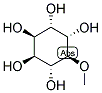
| Industry Category | Chemicals/Carboxylic Acid Derivatives/Esters |
|---|---|
| Product Category | |
| Brand: | |
| Spec: |


